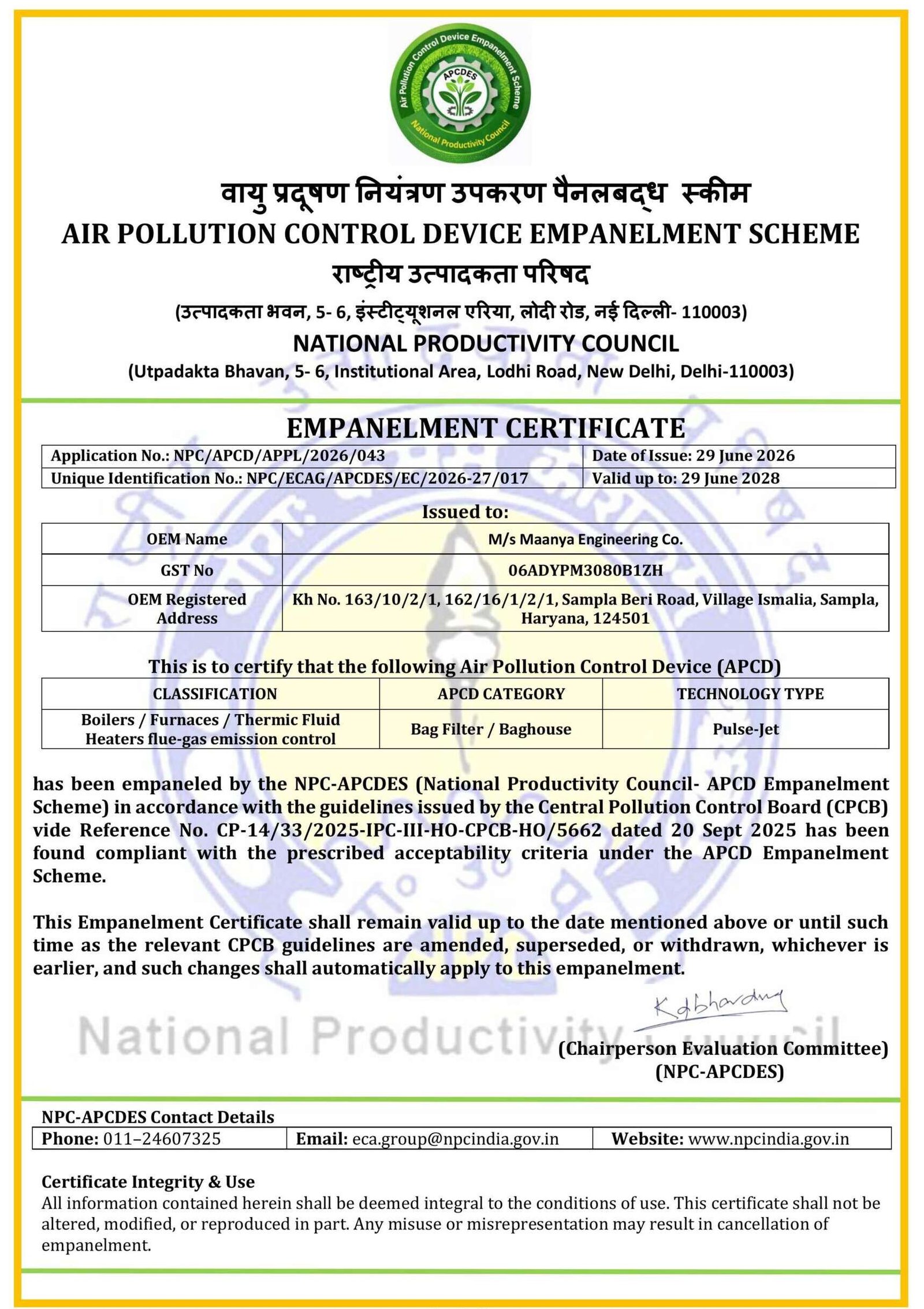
Pollution control equipment plays an essential role in reducing emissions and maintaining safe industrial boiler operations.
Bag Filters
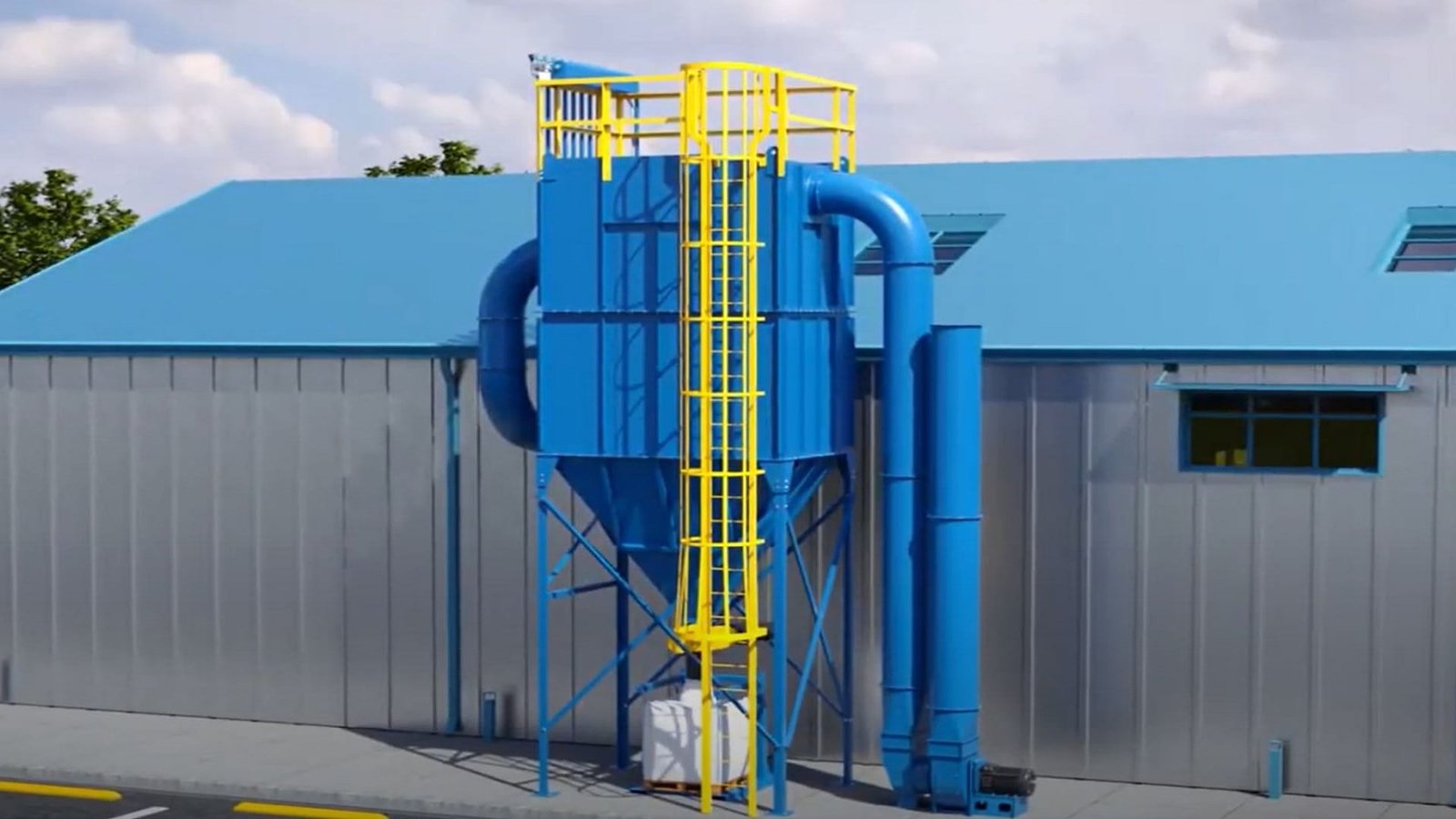
Bag filters in boiler are air pollution controlling industrial equipment, used prominently in a steam boiler house assembly.
It is used to control the level of sulphur dioxide and other.
cyclone
Cyclone separators or simply cyclones are separation devices that use the principle of inertia to remove particulate matter from fuel gases.
Cyclone separator is one of many air pollution control devices known as pre cleaner since they generally remove larger pieces of particulate matter.
This prevent finer filtration methods from having to deal with large , more abrasive particles later on.
In addition, several cyclone separators can operate in parallel and this system is known as a multi cyclone.
wet scrubber
They are also referred to as wet absorption scrubber or wet collectors, employ liquid solutions.
Typically water to collect and remover water- soluble gas and particulate pollutants from industrial emissions.
The wet scrubbing process either passes a gas steam through a liquid solution or injects a liquid solution into gas stream .
As the gas stream comes into contact with liquid , the solution absorbs the pollutants removing it from streams .
The type of wet scrubbing equipment available include Venturi, packed bed & bubbling scrubber.
Pollution Control Equipment – Technical Information & FAQs (Click to expand)
Pollution Control Equipment – Maanya Boilers
Pollution Control Equipment is essential for any industrial steam plant that wants to meet regulatory limits, protect worker health, and reduce environmental impact.
Maanya Boilers supplies, integrates, and supports a range of pollution control equipment tailored to boiler installations — from small package units to large process plants.
This block highlights core technologies, practical selection advice, and the three product types featured on this page:
Wet Scrubber,
Cyclone, and
Bag Filters.
Why Install Pollution Control Equipment?
Installing the right pollution control equipment ensures compliance with ambient air quality norms, reduces particulate emissions, and improves overall plant efficiency.
Properly selected equipment lowers stack loading, reduces ash carryover, and helps plants avoid penalties and shutdowns.
Maanya Boilers recommends a systems-based approach where the pollution control equipment selection matches fuel type, boiler capacity, and site-specific emission targets.
How We Approach Equipment Selection
When advising on pollution control equipment, our engineers review:
- Fuel characteristics (ash %, particle size, moisture)
- Boiler capacity and flue gas volume
- Required outlet emission levels (mg/Nm³)
- Available footprint and layout constraints
- Operation & maintenance capabilities on-site
Using that information we propose a configuration that balances capital cost, operating cost, and emission performance.
Wet Scrubber – Efficient Gas Cleaning
Wet scrubbers remove soluble gases and fine particulates by contacting the flue gas with a scrubbing liquid.
They are particularly effective where particulate size includes sub-micron fractions or where acidic gases must be neutralized.
Typical benefits include:
- High collection efficiency for fine particles
- Simultaneous removal of gaseous contaminants (with proper scrubbing chemistry)
- Compact footprint for high-load applications
Maanya Boilers supplies packaged wet scrubber systems compatible with our boiler ranges.
For product details, visit Wet Scrubber or Contact our engineering team for sizing and liquid handling guidance.
Cyclone – Robust Primary Dust Removal
Cyclone separators (multi-cyclone or single-stage) are a cost-effective first line of defense for coarse particulates generated by solid-fuel combustion.
Cyclones offer:
- Simple design and low maintenance
- High reliability for large particle capture
- Low operating cost and no consumables
We often recommend a cyclone as a primary stage ahead of a bag filter or wet scrubber when firing biomass, coal, or agro-residues.
See the Cyclone section to request a datasheet and recommended inlet conditions.
Bag Filters – Fine Particulate Control
Bag filters (fabric filters) are used where stringent particulate limits are required.
With pulse-jet cleaning and modular baghouses, these systems provide:
- Very high collection efficiency (down to sub-micron levels)
- Modular scalability to match boiler capacities
- Ease of maintenance with replaceable filter elements
Maanya Boilers integrates bag filters with appropriate ducting, pulse-jet systems, and reserve area for bag change-out.
For retrofit projects we provide a full assessment to determine required bag area and differential-pressure set points.
See Bag Filters for installation examples.
Combined Systems & Typical Configurations
Depending on duty and emissions target, a typical configuration may be:
- Cyclone → Bag Filter (common for biomass and coal-fired units)
- Cyclone → Wet Scrubber (where gas absorption is also required)
- Bag Filter alone (where particulate size and load justify direct bagging)
These combinations are part of how Maanya Boilers ensures that the selected pollution control equipment both meets emission norms and aligns with site operational capacity.
Installation, Commissioning & Maintenance
Our service scope for pollution control equipment includes site survey, structural steel and duct routing support, commissioning of cleaning systems (pulse-jet controllers, spray nozzles), and operator training.
Regular maintenance—filter element replacement, cyclone inspection, and scrubber liquor control—is critical to maintain guaranteed performance.
Regulatory & Reference Links
For regulation references and emission standards consult the Central Pollution Control Board (CPCB) and local state directives.
Helpful resources:
Quick Links (Click to Request More)
- Wet Scrubber – product & sizing
- Cyclone – multi-stage options
- Bag Filters – baghouse solutions
- Contact Maanya Boilers – Request a quote
FAQs – Pollution Control Equipment
Q: Which pollution control equipment is best for agro-residue firing?
A: For agro-residues we often recommend a cyclone followed by a bag filter for coarse+fine capture; wet scrubbers may be considered when soluble gases or very fine particulates are present.
Q: How often do bag filters need servicing?
A: Filter life depends on duty and ash abrasiveness; routine inspections and scheduled bag replacement (annually or semi-annually) ensure consistent performance.
Q: Does a wet scrubber need a waste disposal system?
A: Yes—scrubber effluent management (settling, neutralization, and disposal) is part of system design and is provided by Maanya Boilers as required.
About Maanya Boilers – Additional Technical Overview
Maanya Boilers Pvt. Ltd. has established itself as a trusted manufacturer of industrial steam solutions, serving a wide range of sectors across India.
The company emphasizes engineering precision, operational safety and long-term performance across all of its boiler models.
Over the years, the organization has invested in research, fabrication upgrades and improved manufacturing techniques to meet modern industrial requirements.
The engineering team at Maanya Boilers works closely with clients to understand site conditions, production patterns and resource availability.
This approach ensures that equipment recommendations align with real on-ground usage and long-term operational goals.
A systematic evaluation process is used before finalizing specifications, which includes thermal calculations, material selection and pressure component sizing.
The company operates with strict quality standards, following recognized fabrication norms and multiple quality checkpoints throughout the manufacturing cycle.
Every unit undergoes inspections, hydro tests and performance trials before dispatch, ensuring consistent delivery and reliability once installed at the client’s location.
These procedures help reduce installation challenges and shorten commissioning timelines.
In addition to equipment supply, Maanya Boilers offers a complete service ecosystem that includes installation supervision, commissioning assistance and operator training.
Dedicated service teams are available for periodic maintenance visits, troubleshooting support and spare-part planning.
This comprehensive support structure helps industries maintain predictable steam output and minimize unexpected downtime.
The organization continues to expand its capabilities through technology partnerships, upgraded fabrication tools and greater attention to sustainability.
With a focus on energy efficiency, emissions compliance and improved lifecycle performance, Maanya Boilers strives to deliver industrial solutions built for the future.
This section expands on the company’s background and engineering culture to meet recommended documentation standards while keeping the main page layout unchanged.
It adds technical and corporate context relevant to industrial buyers and supports a more complete understanding of the company’s operations.
This section expands on the company’s background and engineering culture to meet recommended documentation standards while keeping the main page layout unchanged.
It adds technical and corporate context relevant to industrial buyers and supports a more complete understanding of the company’s operations.
This section expands on the company’s background and engineering culture to meet recommended documentation standards while keeping the main page layout unchanged.
It adds technical and corporate context relevant to industrial buyers and supports a more complete understanding of the company’s operations.
This section expands on the company’s background and engineering culture to meet recommended documentation standards while keeping the main page layout unchanged.
It adds technical and corporate context relevant to industrial buyers and supports a more complete understanding of the company’s operations.
This section expands on the company’s background and engineering culture to meet recommended documentation standards while keeping the main page layout unchanged.
It adds technical and corporate context relevant to industrial buyers and supports a more complete understanding of the company’s operations.
This section expands on the company’s background and engineering culture to meet recommended documentation standards while keeping the main page layout unchanged.
It adds technical and corporate context relevant to industrial buyers and supports a more complete understanding of the company’s operations.