

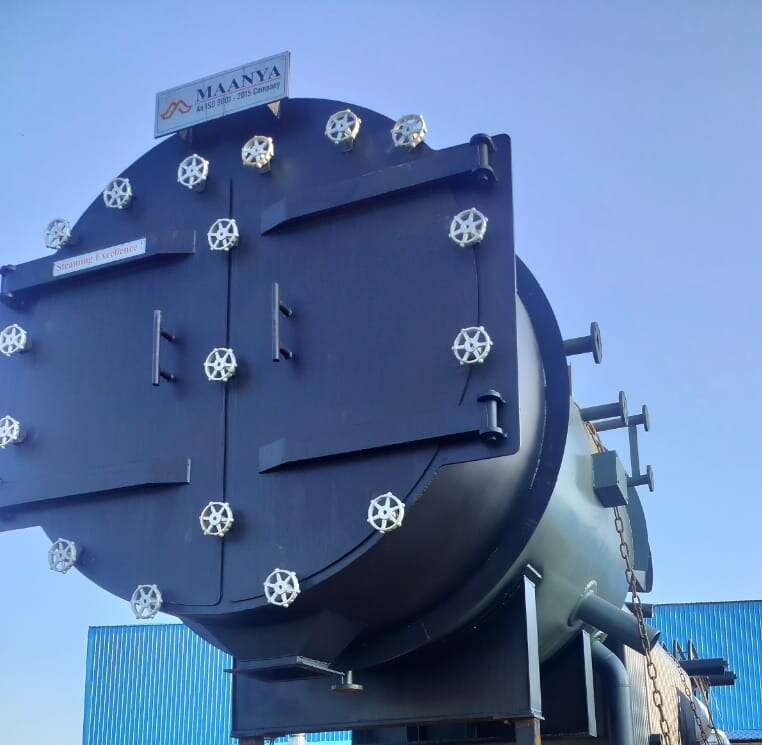
Case Study: Petromax Steam Boiler in Practice
Steam Boiler Explained: What Is a Steam Boiler?
A steam boiler is a pressure vessel that converts water into steam by transferring heat from a fuel source. The generated steam is widely used for heating, sterilization, drying, cleaning, processing, power generation, and various industrial applications.
In simple terms, a steam boiler is the heart of an industrial steam generation system. It produces steam under controlled pressure and temperature, ensuring a continuous supply of thermal energy for manufacturing operations.
Modern steam boilers are designed to deliver high efficiency, safe operation, and long service life. Depending on industrial requirements, they can operate using fuels such as Furnace Oil (FO), Light Diesel Oil (LDO), Natural Gas, LPG, or other approved fuels. Choosing the right boiler depends on factors like steam demand, operating pressure, production capacity, and fuel availability.
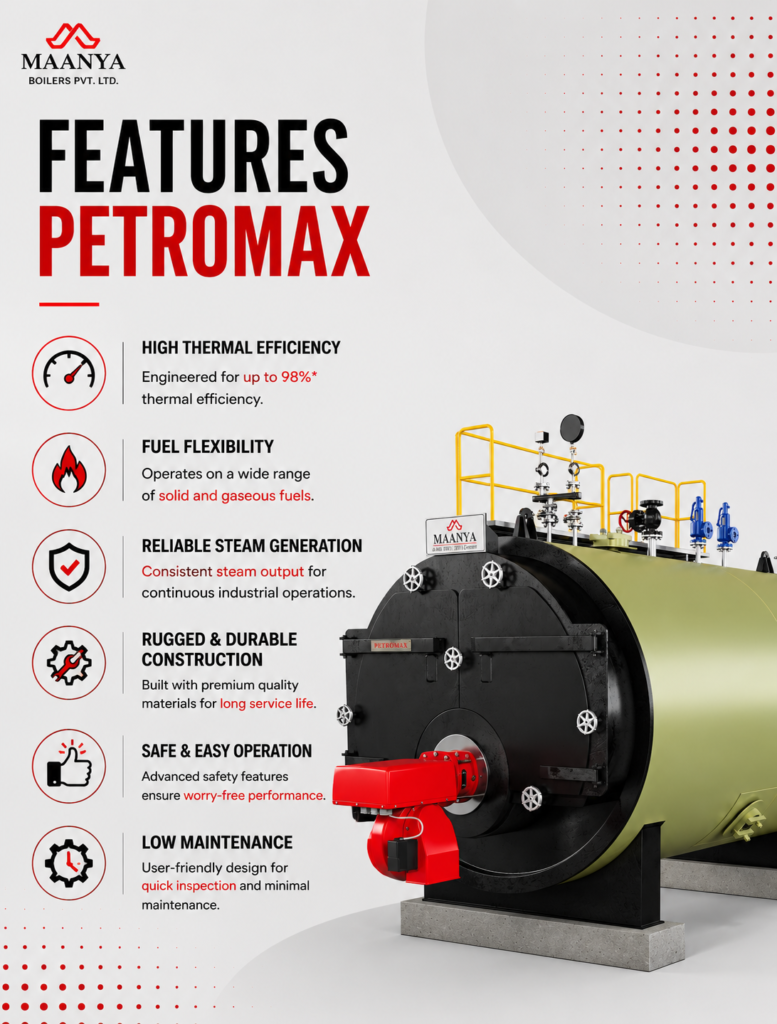
The PETROMAX Boiler from Maanya Boilers is engineered to provide reliable steam generation with efficient heat transfer, durable construction, and dependable performance for industries that require uninterrupted steam throughout their production process.
Why Are Steam Boilers Important?
Steam remains one of the most efficient and reliable methods of heat transfer used in industries today. Compared to many direct heating methods, steam provides faster heating, precise temperature control, and consistent energy distribution.
Industries depend on steam boilers because they help:
- Maintain stable process temperatures
- Improve production efficiency
- Reduce processing time
- Support hygienic and sterile operations
- Deliver controlled heat for sensitive applications
- Improve overall energy utilization
- Ensure continuous industrial operations
Without an efficient steam boiler, industries may experience inconsistent heating, lower product quality, increased fuel consumption, and costly production downtime.
Understanding the PETROMAX Boiler
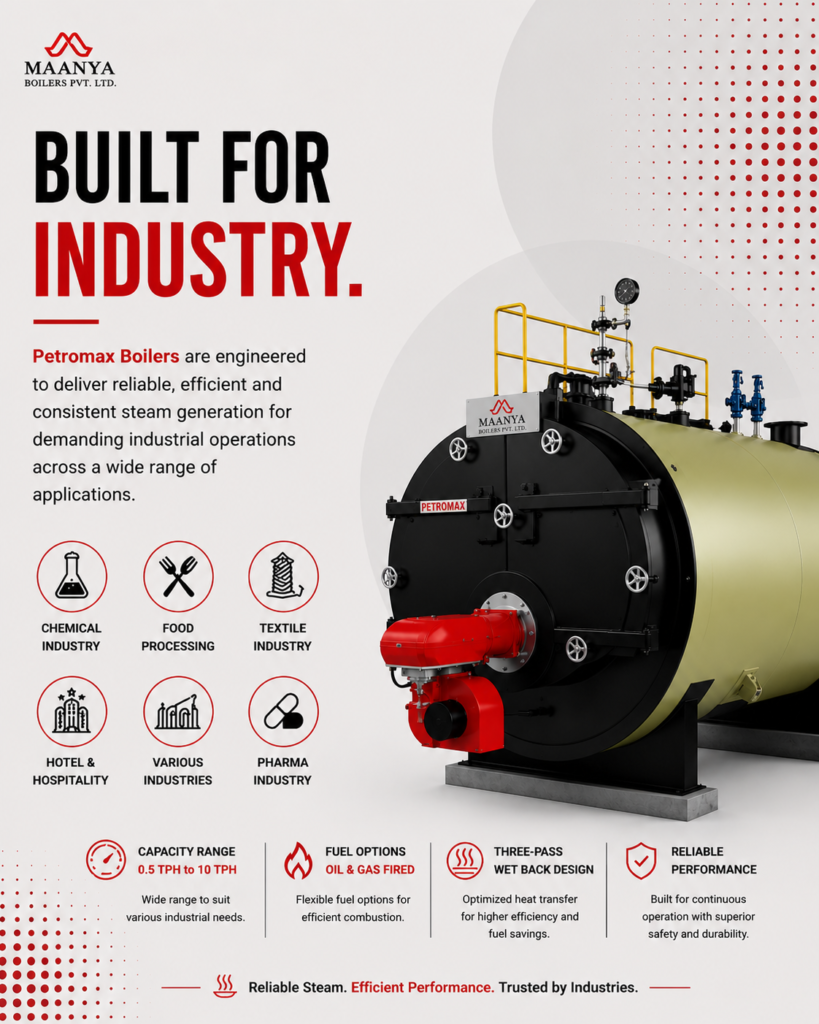
The PETROMAX Boiler from Maanya Boilers is an industrial steam boiler designed to deliver dependable steam generation for a wide range of manufacturing industries. Built with robust engineering and quality components, it is suitable for businesses that require consistent steam output and reliable performance.
Key features of the PETROMAX Boiler include:
- Reliable steam generation
- High thermal efficiency
- Stable operating performance
- Robust construction
- Easy operation
- Simplified maintenance
- Long service life
Whether it’s food processing, textiles, pharmaceuticals, or chemical manufacturing, the PETROMAX Boiler is designed to meet diverse industrial steam requirements while supporting efficient day-to-day operations.
👉 Learn more about the PETROMAX Boiler:
https://maanyaboilers.co.in/petromax-boiler/
Common Applications of Steam Boilers
Steam boilers are widely used because steam is a versatile and highly efficient source of industrial heat.
Some of the major applications include:
Food Processing
Steam is used for cooking, sterilization, pasteurization, blanching, drying, and cleaning production equipment.
Rice Mills
Steam supports parboiling, moisture conditioning, grain processing, and quality improvement.
Textile Industry
Steam plays an important role in dyeing, bleaching, washing, finishing, and fabric processing.
Pharmaceutical Industry
Clean steam is essential for sterilization, process heating, and maintaining hygienic manufacturing conditions.
Chemical Industry
Steam provides process heating for reactors, distillation units, and various chemical manufacturing operations.
Dairy Processing
Steam is widely used for pasteurization, sterilization, equipment cleaning, and milk processing.
Paper & Packaging Industry
Steam assists in paper drying, finishing, shrink wrapping, heat sealing, and packaging operations.
Because of its versatility and efficiency, steam continues to be one of the most preferred heat sources across manufacturing industries.
Why Businesses Trust Maanya Boilers
Selecting a steam boiler is more than purchasing equipment—it’s choosing a long-term engineering partner.
Maanya Boilers provides industrial steam solutions designed to improve efficiency, reliability, and operational performance. Along with steam boilers, the company also offers biomass boilers, pollution control equipment, and water treatment solutions to support complete industrial heating systems.
Every solution is recommended based on the customer’s production requirements, helping industries choose equipment that aligns with their operational goals.
About Maanya Boilers:
https://maanyaboilers.co.in/about-us/
Understanding the Working Principle of a Steam Boiler
To fully understand how a steam boiler works, it’s important to know how water is converted into steam safely and efficiently.
A steam boiler works on a simple principle:
Heat generated from fuel combustion is transferred to water until it converts into steam under controlled pressure.
Although the process appears straightforward, it involves several carefully designed components working together to produce steam continuously and efficiently.
The generated steam is then supplied through insulated pipelines to various industrial processes, where it transfers heat before condensing back into water. In many systems, this condensate is recovered and reused, improving overall efficiency and reducing operating costs.
Steam Boiler Explained: Step-by-Step Steam Generation Process
Every industrial steam boiler follows a systematic cycle to ensure safe and efficient steam production.
Step 1 – Feed Water Enters the Boiler
The process begins with treated feed water entering the boiler.
Before entering the system, water is treated to remove impurities, dissolved minerals, and salts that can cause scaling or corrosion.
Proper water treatment helps:
- Improve heat transfer
- Reduce fuel consumption
- Prevent scale formation
- Extend boiler life
- Reduce maintenance costs
For this reason, many industries install dedicated water treatment systems alongside their steam boilers.
Step 2 – Fuel Combustion
Once the boiler is filled with feed water, fuel is supplied to the burner.
Depending on the application, the PETROMAX Boiler can operate using:
- Furnace Oil (FO)
- Light Diesel Oil (LDO)
- Natural Gas
- LPG
The burner mixes fuel with the correct amount of air to create efficient combustion. Maintaining the proper air-to-fuel ratio helps improve efficiency while reducing fuel wastage and emissions.
Step 3 – Heat Transfer
The combustion process generates high-temperature flue gases.
Instead of allowing this heat to escape, the boiler directs the hot gases through specially designed heat transfer surfaces, where thermal energy is transferred to the surrounding water.
Efficient heat transfer plays a crucial role in:
- Faster steam generation
- Lower fuel consumption
- Better thermal efficiency
- Reduced operating costs
Step 4 – Steam Formation
As water absorbs heat, it reaches its boiling point under pressure and begins converting into steam.
Unlike water boiling in an open container, industrial boilers operate under pressure, allowing steam to be produced at higher temperatures suitable for industrial applications.
The steam collects in the steam space before being distributed throughout the plant.
Step 5 – Steam Distribution
The generated steam travels through insulated pipelines to different production areas.
Steam is commonly used for:
- Heating process vessels
- Sterilization equipment
- Heat exchangers
- Drying chambers
- Food processing machinery
- Textile processing
- Pharmaceutical manufacturing
- Packaging lines
Because steam carries a large amount of latent heat, it transfers energy efficiently while maintaining consistent process temperatures.
Step 6 – Condensate Recovery
After transferring its heat, steam condenses back into water.
Many industries recover this condensate and return it to the boiler system.
Condensate recovery provides several benefits:
- Reduced water consumption
- Lower fuel costs
- Faster steam generation
- Improved energy efficiency
- Reduced chemical treatment requirements
Recovering condensate is considered one of the best practices for improving boiler efficiency and reducing operating costs.
The Science Behind Heat Transfer
Steam boilers generate heat efficiently through three primary modes of heat transfer.
1. Radiation
Heat from the burner flame is radiated directly onto the furnace walls and heat transfer surfaces, providing the initial stage of energy transfer.
2. Convection
Hot combustion gases flow through the boiler, transferring heat to the metal surfaces surrounding the water. This raises the water temperature and supports steam generation.
3. Conduction
Heat then passes through the boiler’s metal surfaces into the water. High-quality boiler materials are selected to ensure excellent thermal conductivity while maintaining strength under high pressure and temperature.
The combination of radiation, convection, and conduction enables efficient steam generation with minimal energy loss.
Fire Tube vs. Water Tube Boilers
Understanding the difference between fire tube and water tube boilers helps industries select the right boiler for their specific applications.
| Feature | Fire Tube Boiler | Water Tube Boiler |
|---|---|---|
| Heat Flow | Hot gases pass through tubes | Water flows through tubes |
| Pressure Range | Low to Medium | Medium to High |
| Steam Capacity | Moderate | High |
| Maintenance | Easier | More Specialized |
| Initial Cost | Lower | Higher |
| Common Applications | Food Processing, Rice Mills, Textiles, Packaging | Power Plants & Large Process Industries |
The PETROMAX Boiler is designed to provide dependable steam generation for industries where operational reliability, thermal efficiency, and ease of maintenance are essential.
Why Combustion Efficiency Matters
Combustion efficiency directly affects the overall performance and operating cost of a steam boiler.
Higher combustion efficiency results in:
- Lower fuel consumption
- Reduced operating costs
- Better steam quality
- Lower emissions
- Longer equipment life
Factors that influence combustion efficiency include:
- Burner performance
- Fuel quality
- Correct air-to-fuel ratio
- Clean heat transfer surfaces
- Regular preventive maintenance
- Proper insulation
Routine inspections and burner tuning help maintain consistent performance and reduce unnecessary energy losses.
Common Factors Affecting Steam Boiler Performance
Several factors influence how efficiently a steam boiler operates.
Water Quality
Poor feed water can cause scaling, corrosion, and reduced heat transfer efficiency.
Fuel Quality
Using clean, high-quality fuel helps maintain stable combustion and consistent performance.
Boiler Load
Operating the boiler close to its designed capacity generally provides better efficiency than frequent start-stop cycles.
Preventive Maintenance
Regular inspection, cleaning, and servicing help improve reliability, reduce breakdowns, and extend equipment life.
How the PETROMAX Boiler Supports Efficient Steam Generation
The PETROMAX Boiler is designed to deliver dependable steam generation with a focus on efficiency, durability, and operational reliability.
Its engineering emphasizes:
- Efficient heat transfer
- Reliable steam output
- Robust construction
- Stable combustion
- Easy operation
- Simplified maintenance
When combined with proper installation, feed water treatment, and routine maintenance, the PETROMAX Boiler helps industries achieve efficient and uninterrupted steam generation.
For technical specifications and available models, explore:
PETROMAX Boiler:
https://maanyaboilers.co.in/petromax-boiler/
Water Treatment Solutions:
https://maanyaboilers.co.in/water-solution-equipment/
Pollution Control Equipment:
https://maanyaboilers.co.in/pollution-control-equipment/
The Anatomy of a Steam Boiler
Now that we’ve understood the working principle of a steam boiler, let’s explore the major components that make steam generation possible.
A modern industrial steam boiler is a carefully engineered system where each component contributes to safe, efficient, and reliable operation. Understanding these components helps industries make informed decisions when selecting or maintaining a boiler.
1. Burner – The Starting Point of Steam Generation
The burner initiates the steam generation process by mixing fuel with air and producing a controlled flame.
Its primary functions include:
- Ensuring efficient fuel combustion
- Delivering a stable flame
- Minimizing fuel wastage
- Reducing emissions
- Supporting safe ignition and shutdown
Modern burners automatically regulate the air-to-fuel ratio based on steam demand, improving efficiency while reducing operating costs.
2. Furnace – Where Heat Is Generated
The furnace is the combustion chamber where fuel burns to generate high temperatures.
A well-designed furnace helps:
- Achieve complete combustion
- Distribute heat evenly
- Improve fuel efficiency
- Reduce soot formation
- Protect the boiler structure
Efficient combustion inside the furnace plays a major role in maximizing thermal performance.
3. Boiler Shell – The Pressure Vessel
The boiler shell forms the main body of the boiler and safely contains water, steam, and internal components under pressure.
A quality boiler shell provides:
- High structural strength
- Pressure resistance
- Corrosion resistance
- Long service life
Regular inspection and maintenance help preserve its integrity and ensure safe operation.
4. Fire Tubes – The Heat Transfer System
In a fire tube boiler, hot combustion gases pass through tubes surrounded by water.
As heat transfers from the gases to the water, steam is generated efficiently.
Clean fire tubes help:
- Improve heat transfer
- Reduce fuel consumption
- Maintain stable steam output
- Lower operating costs
Routine cleaning prevents soot and scale buildup that can reduce efficiency.
5. Steam Space – Where Steam Is Collected
As water converts into steam, it naturally rises into the steam space.
This section of the boiler:
- Collects dry steam
- Separates moisture
- Maintains stable pressure
- Supplies steam to industrial processes
Dry steam improves heat transfer efficiency while protecting downstream equipment.
6. Feed Water Pump
As steam leaves the boiler, the feed water pump continuously supplies treated water to maintain the proper water level.
A reliable feed water system helps:
- Prevent overheating
- Maintain continuous steam production
- Protect internal components
- Improve operational safety
Most modern boilers use automatic water level controls for consistent operation.
7. Safety Valve
The safety valve is one of the most critical safety components in any steam boiler.
If boiler pressure exceeds the allowable limit, the safety valve automatically releases excess steam to protect the system.
Regular testing and inspection are essential to ensure reliable operation.
8. Pressure Gauge
The pressure gauge continuously displays the boiler’s operating pressure.
It enables operators to:
- Monitor system performance
- Detect abnormal pressure changes
- Maintain safe operating conditions
- Support preventive maintenance
9. Blowdown Valve
Over time, dissolved solids accumulate inside boiler water.
The blowdown valve removes a controlled amount of water containing these impurities, helping to:
- Reduce scaling
- Prevent corrosion
- Improve heat transfer
- Extend boiler life
- Maintain water quality
Proper blowdown practices also contribute to better fuel efficiency.
10. Chimney
After combustion is complete, flue gases exit the boiler through the chimney.
A properly designed chimney supports:
- Stable combustion
- Safe exhaust gas discharge
- Efficient burner operation
- Compliance with environmental standards
When combined with pollution control equipment, it helps reduce environmental impact.
11. Control Panel
The control panel acts as the operating center of the boiler.
Modern control systems monitor and regulate:
- Steam pressure
- Water level
- Burner operation
- Temperature
- Safety interlocks
- Alarm conditions
Automation improves operational consistency while enhancing safety and efficiency.
How All These Components Work Together
Every component inside a steam boiler performs a specific function, but maximum efficiency is achieved when they operate as one integrated system.
The feed water pump supplies treated water into the boiler, while the burner ignites fuel inside the furnace to generate heat. Heat passes through the fire tubes and transfers to the surrounding water, producing steam. The steam collects in the steam space before being distributed throughout the plant.
Throughout the process, the pressure gauge monitors operating pressure, the control panel regulates performance, the blowdown valve maintains water quality, and the safety valve protects against excessive pressure. Finally, flue gases leave through the chimney, completing the combustion cycle.
This coordinated operation ensures continuous, efficient, and safe steam generation.
Why Choose the PETROMAX Boiler?
Selecting a steam boiler involves more than comparing specifications. Industries need equipment that delivers reliable performance, efficient operation, and long-term value.
The PETROMAX Boiler from Maanya Boilers is designed with these priorities in mind.
Key advantages include:
- High thermal efficiency
- Reliable steam generation
- Durable construction
- Stable combustion
- User-friendly controls
- Simplified maintenance
- Long operational life
Its design supports consistent steam production while helping industries improve fuel utilization and reduce maintenance requirements.
Key Features of the PETROMAX Boiler
High Thermal Efficiency
Thermal efficiency determines how effectively a boiler converts fuel into usable steam.
A highly efficient boiler offers:
- Lower fuel consumption
- Reduced operating costs
- Faster steam generation
- Better heat utilization
- Lower environmental impact
Maintaining proper water quality and regular servicing helps sustain high efficiency throughout the boiler’s operating life.
Robust Industrial Construction
Industrial boilers often operate continuously under demanding conditions.
The PETROMAX Boiler is built to withstand:
- High operating temperatures
- Continuous pressure cycles
- Heavy industrial workloads
- Long production schedules
Its durable construction contributes to improved reliability and reduced downtime.
Consistent Steam Output
Many manufacturing processes depend on uninterrupted steam supply.
Consistent steam pressure is particularly important for industries such as:
- Food Processing
- Textile Manufacturing
- Pharmaceuticals
- Chemicals
- Dairy Processing
Stable steam generation improves process consistency and product quality.
Efficient Heat Transfer
Efficient heat transfer allows the boiler to generate steam quickly while minimizing fuel consumption.
Benefits include:
- Faster heating
- Better thermal efficiency
- Lower energy losses
- Reduced operating costs
- Higher productivity
Routine cleaning of heat transfer surfaces helps maintain these benefits over time.
Fuel Flexibility
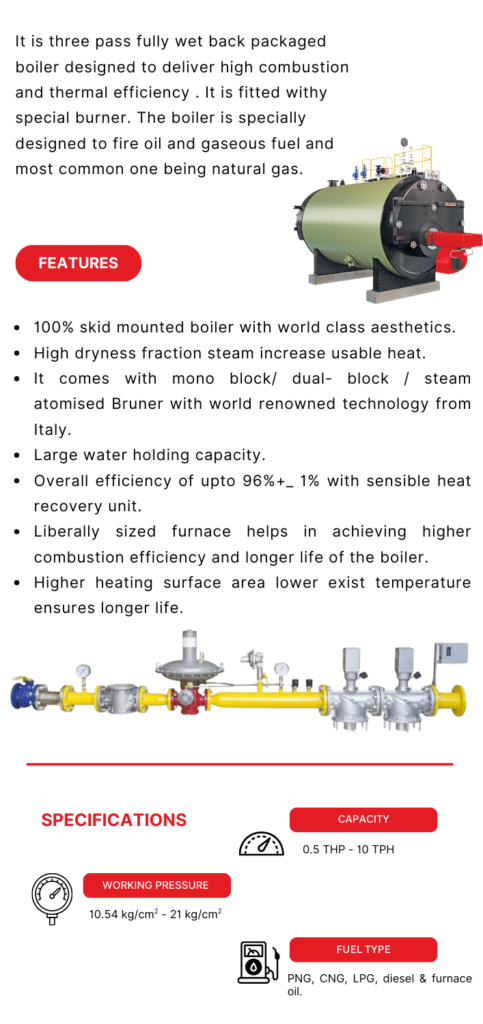
Depending on operational requirements, the PETROMAX Boiler can be configured to operate using:
- Furnace Oil (FO)
- Light Diesel Oil (LDO)
- Natural Gas
- LPG
Selecting the appropriate fuel depends on factors such as availability, operating costs, emissions requirements, and production needs.
User-Friendly Controls
Modern automation simplifies boiler operation by continuously monitoring key operating parameters, including:
- Steam pressure
- Water level
- Burner performance
- Temperature
- Safety systems
This helps improve efficiency while reducing manual intervention.
Maintenance-Friendly Design
Easy access to critical components simplifies inspection and servicing.
Regular preventive maintenance helps:
- Improve efficiency
- Reduce breakdowns
- Lower fuel consumption
- Extend equipment life
- Enhance operational safety
Built-In Safety Features
Steam boilers operate under pressure, making safety a top priority.
The PETROMAX Boiler incorporates multiple safety systems, including:
- Safety valves
- Pressure gauges
- Water level controls
- Automatic burner shutdown
- Alarm systems
Combined with routine inspections and trained operators, these features help ensure reliable and safe operation.
Environmental Responsibility
Efficient steam generation supports lower fuel consumption and improved energy utilization.
When integrated with pollution control equipment and proper combustion practices, industrial boilers can help businesses:
- Reduce emissions
- Improve fuel efficiency
- Support sustainable operations
- Meet environmental regulations
Choosing the Right Steam Boiler
Selecting the right steam boiler requires evaluating more than just steam capacity.
Key considerations include:
- Steam demand
- Operating pressure
- Available fuel
- Future production expansion
- Installation space
- Maintenance requirements
- After-sales support
Working with an experienced manufacturer like Maanya Boilers helps businesses identify a boiler that matches both current and future production requirements.
Complete Industrial Solutions from Maanya Boilers
In addition to the PETROMAX Boiler, Maanya Boilers offers a complete portfolio of industrial heating solutions:
- AGROMAX Series – Biomass-fired steam boilers for agricultural waste fuels.
- AGRIPAC Series – Efficient biomass combustion with reliable steam generation.
- COMBIMAC Series – Versatile boilers for multiple industrial applications.
- MAXPAC Series – Designed for larger steam requirements.
- MINIPAC Series – Compact boilers for smaller industries.
- Biomass Boilers – Supporting sustainable energy generation.
- Pollution Control Equipment – Helping industries manage emissions.
- Water Treatment Solutions – Improving boiler efficiency and protecting equipment.
Together, these solutions enable industries to build efficient, reliable, and integrated steam systems tailored to their operational needs.
Industries Served by Steam Boilers
By now, you’ve understood how a steam boiler works, its major components, and the features that contribute to efficient steam generation. The next question many businesses ask is:
“Will this steam boiler suit my industry?”
The answer depends on your steam demand, operating pressure, production process, and available fuel source. Steam remains one of the most efficient methods of heat transfer, making it suitable for a wide range of manufacturing applications.
The PETROMAX Boiler from Maanya Boilers is designed to meet the steam requirements of diverse industries by delivering reliable performance, efficient heat transfer, and consistent steam output.
Food Processing Industry
Steam plays a vital role in food manufacturing by providing controlled and hygienic heating.
Common applications include:
- Cooking
- Pasteurization
- Sterilization
- Blanching
- Food drying
- Equipment cleaning
A consistent steam supply helps maintain product quality, improve food safety, and support uninterrupted production.
Rice Mills & Grain Processing
Rice mills depend heavily on steam during various processing stages.
Steam is commonly used for:
- Paddy parboiling
- Moisture conditioning
- Grain processing
- Drying
Reliable steam generation improves grain quality while reducing processing time and increasing production efficiency.
Textile Industry
Steam is essential throughout textile manufacturing.
Major applications include:
- Dyeing
- Bleaching
- Washing
- Fabric finishing
- Drying
Stable steam pressure helps maintain fabric quality, improve colour consistency, and support efficient production.
Pharmaceutical Industry
Steam is critical in pharmaceutical manufacturing because hygiene and sterilization are essential.
Applications include:
- Equipment sterilization
- Process heating
- Clean-in-Place (CIP)
- Steam-in-Place (SIP)
- Laboratory processes
Reliable steam generation helps manufacturers maintain product quality while complying with industry standards.
Chemical Industry
Chemical manufacturing often requires accurate temperature control.
Steam supports:
- Reactor heating
- Distillation
- Solvent recovery
- Process heating
- Drying
Consistent steam pressure improves production stability and process efficiency.
Dairy Industry
Steam supports several daily dairy operations, including:
- Pasteurization
- Sterilization
- Milk heating
- Equipment cleaning
- Packaging
Reliable steam generation helps maintain food safety while ensuring smooth production.
Paper Industry
Steam is widely used during:
- Pulp processing
- Paper drying
- Sheet finishing
- Moisture control
A continuous steam supply improves production quality while reducing downtime.
Packaging Industry
Steam supports several packaging operations, including:
- Heat sealing
- Shrink wrapping
- Adhesive activation
- Process heating
Its ability to deliver quick and uniform heat makes it an efficient solution for packaging lines.
Engineering & Manufacturing Industries
Heavy engineering facilities use steam for:
- Component cleaning
- Surface treatment
- Process heating
- Equipment testing
Steam continues to be one of the most efficient and dependable heat sources across manufacturing industries.
Why Choose Maanya Boilers?
Choosing the right steam boiler is not just about purchasing equipment—it’s about selecting a reliable engineering partner.
At Maanya Boilers, every boiler is designed with a focus on efficiency, durability, and long-term operational reliability. From consultation and manufacturing to installation support and after-sales service, the goal is to provide complete industrial steam solutions that meet each customer’s production requirements.
What Sets Maanya Boilers Apart?
Engineering-Driven Design
Every boiler is developed using practical engineering principles to deliver efficient heat transfer, dependable steam generation, and reliable day-to-day performance.
Quality Manufacturing
Each boiler is manufactured using quality materials and undergoes strict quality checks to ensure durability, safety, and long service life.
Customized Steam Solutions
Every industry has unique production requirements.
Maanya Boilers helps customers select the right boiler based on:
- Steam capacity
- Fuel availability
- Operating pressure
- Production process
- Future expansion requirements
This ensures the selected solution matches both current and future operational needs.
Reliable After-Sales Support
A steam boiler is a critical production asset.
Timely service, technical assistance, maintenance guidance, and spare parts availability help minimize downtime and support uninterrupted production.
Focus on Long-Term Value
Rather than simply supplying equipment, Maanya Boilers focuses on delivering solutions that improve efficiency, reduce operating costs, and support sustainable industrial growth.
Explore the Complete Product Range from Maanya Boilers
Every manufacturing process has different steam generation requirements. To serve diverse industries, Maanya Boilers offers a complete portfolio of industrial heating solutions.
PETROMAX Boiler
Designed for industries requiring dependable steam generation using oil or gas-based fuels, the PETROMAX Boiler delivers reliable performance, efficient combustion, and consistent steam output.
AGROMAX Series
The AGROMAX Series is designed for biomass-fired steam generation using agricultural waste fuels, helping industries reduce fuel costs while supporting sustainable operations.
AGRIPAC Series
AGRIPAC Boilers provide efficient biomass combustion with a strong focus on fuel flexibility, operational reliability, and consistent steam generation.
COMBIMAC Series
The COMBIMAC Series is engineered for a wide range of industrial applications requiring dependable steam production and durable construction.
MAXPAC Series
Designed for higher steam capacities, the MAXPAC Series supports industries where continuous operation and maximum productivity are essential.
MINIPAC Series
Compact and efficient, the MINIPAC Series is suitable for industries with lower steam requirements or limited installation space.
Pollution Control Equipment
Maanya Boilers also offers pollution control solutions that help industries reduce emissions and comply with environmental regulations.
Water Treatment Solutions
Proper feed water treatment improves boiler efficiency by minimizing scaling, corrosion, and maintenance requirements while extending equipment life.
Why Investing in the Right Steam Boiler Matters
A steam boiler is a long-term investment that directly affects production efficiency and operating costs.
Choosing the right boiler can help industries:
- Reduce fuel consumption
- Improve production efficiency
- Lower maintenance costs
- Minimize unexpected downtime
- Extend equipment life
- Improve workplace safety
- Maintain consistent product quality
- Support future production expansion
Working with an experienced manufacturer ensures that the selected boiler continues to deliver reliable performance throughout its operational life.
How the Right Boiler Improves Industrial Productivity
Beyond steam generation, an efficient boiler contributes to overall plant performance by:
- Reducing energy losses
- Improving thermal efficiency
- Supporting continuous production
- Lowering operating expenses
- Simplifying maintenance
- Increasing equipment reliability
When combined with proper installation, routine servicing, and quality feed water treatment, a well-designed steam boiler becomes an important asset for long-term industrial growth.
Steam Boiler Maintenance Best Practices
Even the most advanced steam boiler requires regular maintenance to operate safely and efficiently. A well-planned preventive maintenance program not only improves performance but also extends equipment life and reduces unexpected downtime.
Following these best practices helps maintain reliable steam generation while lowering operating costs.
✔ Monitor Water Quality
Feed water quality has a direct impact on boiler performance.
Untreated water can lead to:
- Scale formation
- Corrosion
- Reduced heat transfer
- Higher fuel consumption
- Premature equipment wear
Using properly treated water helps improve efficiency and protects critical boiler components.
✔ Inspect the Burner Regularly
The burner plays a crucial role in fuel combustion.
Regular inspection and cleaning help maintain:
- Efficient combustion
- Stable flame characteristics
- Lower fuel consumption
- Reduced emissions
A properly tuned burner also improves overall boiler performance.
✔ Clean Heat Transfer Surfaces
Over time, soot and deposits can accumulate on heat transfer surfaces.
Routine cleaning helps:
- Improve thermal efficiency
- Increase steam generation
- Reduce fuel wastage
- Prevent overheating
Even a thin layer of deposits can significantly reduce heat transfer efficiency.
✔ Test Safety Devices
Steam boilers operate under pressure, making safety inspections essential.
Regularly inspect:
- Safety valves
- Pressure gauges
- Water level controls
- Alarm systems
- Automatic shutdown mechanisms
Testing these components ensures the boiler continues operating safely under varying load conditions.
✔ Follow a Preventive Maintenance Schedule
Scheduled inspections help identify small issues before they become major repairs.
A preventive maintenance plan should include:
- Burner servicing
- Tube cleaning
- Blowdown checks
- Leak inspections
- Instrument calibration
- Safety device testing
Routine maintenance reduces downtime and improves long-term reliability.
✔ Train Boiler Operators
Well-trained operators contribute significantly to safe and efficient boiler operation.
Proper training helps operators:
- Monitor boiler performance
- Identify abnormal operating conditions
- Follow safe operating procedures
- Reduce unnecessary fuel consumption
- Respond effectively during emergencies
Skilled operators help maximize both safety and equipment life.
Frequently Asked Questions (FAQ)
1. What is a steam boiler?
A steam boiler is a pressure vessel that converts water into steam using heat generated through fuel combustion. The steam is then used for heating, sterilization, drying, processing, and various industrial applications.
2. Which industries use steam boilers?
Steam boilers are widely used across industries such as:
- Food Processing
- Rice Mills
- Textile Manufacturing
- Pharmaceuticals
- Chemicals
- Dairy Processing
- Paper Manufacturing
- Packaging
- Engineering Industries
Any industry requiring reliable process heating can benefit from an efficient steam boiler.
3. Why is water treatment important?
Proper feed water treatment helps prevent scaling, corrosion, and mineral deposits that reduce efficiency and damage boiler components.
Good water quality also improves heat transfer, lowers maintenance costs, and extends the operational life of the boiler.
4. How do I choose the right steam boiler?
Selecting the right steam boiler depends on several factors, including:
- Required steam capacity
- Operating pressure
- Fuel availability
- Installation space
- Future production expansion
- Maintenance requirements
- After-sales support
Consulting with an experienced manufacturer like Maanya Boilers helps ensure the selected boiler matches your operational requirements.
5. Why choose the PETROMAX Boiler from Maanya Boilers?
The PETROMAX Boiler is designed to deliver reliable steam generation through efficient combustion, effective heat transfer, and durable construction.
Combined with Maanya Boilers’ engineering expertise and customer support, it provides industries with a dependable and long-lasting steam generation solution.
Conclusion
Understanding Steam Boiler Explained goes beyond knowing what a steam boiler is. It involves understanding how steam is generated, how key components work together, why efficient heat transfer matters, and how the right boiler can improve industrial productivity.
Throughout this guide, we’ve explored the working principle of steam boilers, their major components, essential features, industrial applications, maintenance practices, and key considerations for selecting the right system.
For industries seeking dependable steam generation, the PETROMAX Boiler from Maanya Boilers offers a practical combination of efficiency, durability, and reliable performance. Whether you’re setting up a new manufacturing facility or upgrading an existing steam system, investing in the right boiler helps improve productivity, reduce operating costs, and support long-term operational success.
As industries continue to focus on efficiency and sustainability, choosing a well-engineered steam boiler backed by reliable technical support becomes increasingly important.
Ready to Power Your Industry with Reliable Steam?
Whether you’re looking for a steam boiler for a food processing unit, rice mill, textile factory, pharmaceutical plant, chemical industry, dairy, paper mill, or packaging facility, the team at Maanya Boilers is ready to help.
Our experts can assist you with:
- Selecting the right boiler capacity
- Comparing suitable fuel options
- Understanding installation requirements
- Planning future production expansion
- Choosing the right steam solution for your industry
Contact Maanya Boilers today:
https://maanyaboilers.com/contact-us/
📱 Continue the Learning Journey
You’ve now explored the complete guide to industrial steam boilers.
To see these concepts explained visually, visit @maanyaboilers_official on Instagram and explore our PETROMAX Boiler educational series. Each post covers important boiler concepts through simple visuals, practical explanations, and industry-focused insights.
For an even better reader experience, you can embed the relevant Instagram posts throughout this blog to complement each section and encourage visitors to explore more educational content from Maanya Boilers.
No responses yet