

Biomass Boiler Fuel Consumption and Efficiency: What to Expect per Tonne of Steam?
When evaluating a biomass boiler, fuel consumption is one of the first operating costs industries want to estimate. A common question is how many kilograms of biomass fuel are needed to produce one tonne of steam.
However, no single consumption figure applies to every boiler. The required fuel depends on the energy needed to produce the specified steam, the feedwater condition, the biomass’s heating value and moisture content, and the boiler’s efficiency.
For this reason, a reliable calculation should begin with an energy balance rather than a generic kg-per-tonne estimate.
How Is Biomass Boiler Fuel Consumption Calculated?
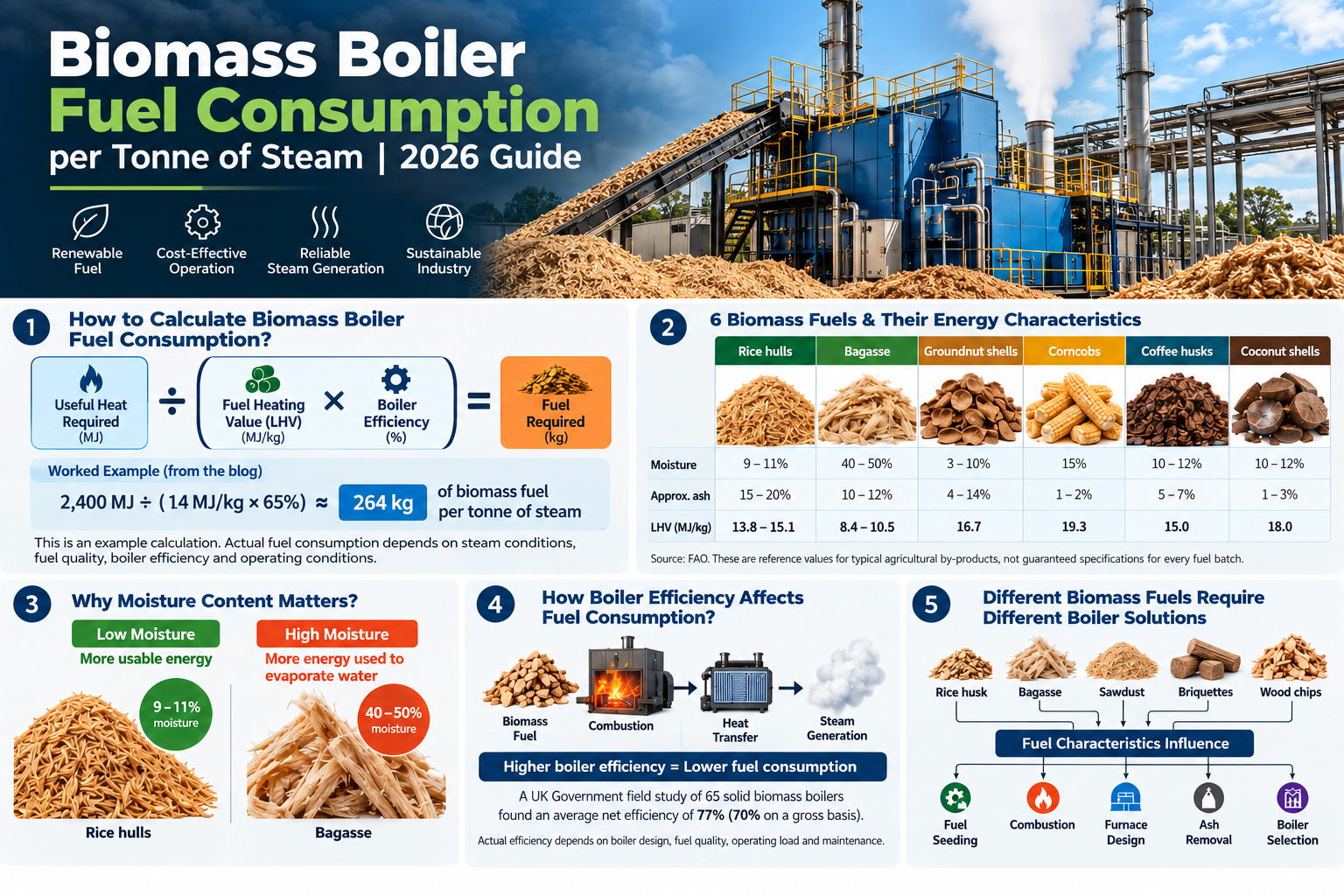
The basic relationship is:
Fuel required = Useful heat required ÷ (Fuel heating value × Boiler efficiency)
The useful heat required to produce steam depends on the difference between the enthalpy of the required steam and the enthalpy of the incoming feedwater.
NIST’s Steam Properties Database provides thermodynamic properties, including enthalpy, pressure, temperature and internal energy, using formulations developed by the IAPWS (International Association for the Properties of Water and Steam). You can use these properties to determine the heat required for a specific steam-generation condition.
This means two plants producing one tonne of steam can have different fuel requirements if their steam pressure or feedwater conditions differ.
Why Steam Pressure Matters?
The phrase “one tonne of steam” does not completely define the energy requirement.
Steam at different pressures and temperatures has different thermodynamic properties. Consequently, an engineer needs to know the required steam and feedwater conditions before calculating the required heat.
Therefore, quoting a fixed figure such as “300 kg of biomass per tonne of steam” without specifying the operating conditions does not provide a technically complete answer.
Why Biomass Fuel Quality Changes Consumption?
Once the steam-side heat requirement is established, the next important variable is the energy available in the biomass fuel. FAO publishes data showing that agricultural residues can have substantially different lower heating values (LHV), moisture levels and ash contents.
| Biomass fuel | Moisture* | Approx. ash | LHV |
| Rice hulls | 9 to 11% | 15 to 20% | 13.8 to 15.1 MJ/kg |
| Bagasse | 40 to 50% | 10 to 12% | 8.4 to 10.5 MJ/kg |
| Groundnut shells | 3 to 10% | 4 to 14% | 16.7 MJ/kg |
| Corncobs | 15% | 1 to 2% | 19.3 MJ/kg |
| Coffee husks | 10 to 12% | 5 to 7% | 15.0 MJ/kg |
| Coconut shells | 10 to 12% | 1 to 3% | 18.0 MJ/kg |
These are FAO reference values for typical agricultural by-products, not guaranteed specifications for every fuel batch. Characterise actual biomass before using a particular heating value for engineering calculations.
This is why the price per tonne of biomass alone is not enough to compare fuels. The energy available from each tonne must also be considered.
Why Moisture Content Matters?
Moisture directly affects biomass’s usable energy. Energy is required to heat and evaporate water contained in the fuel before the combustible material can release its energy effectively.
FAO notes that the energy value of agricultural by-products depends on factors including moisture and ash content.
Its published data provides a clear example. Bagasse is listed with 40 to 50% moisture and an LHV of 8.4 to 10.5 MJ/kg, while rice hulls are listed with 9 to 11% moisture and an LHV of 13.8 to 15.1 MJ/kg.
Do not interpret these figures as universal properties of bagasse or rice hull. Moisture and composition vary by source, season and processing conditions. For a biomass fuel boiler, testing the actual fuel is therefore preferable to relying on a generic database value.
What Efficiency Should You Expect from a Biomass Boiler?
A UK Government field study measured the performance of 65 solid biomass boilers under real-world operating conditions and found an average net efficiency of 77%, compared with 70% on a gross basis. The study also found that efficiency varied with boiler size and operating conditions.
This makes 77% a useful real-world reference point, but not a guaranteed efficiency for every biomass boiler. Actual performance depends on the boiler design, fuel quality, operating load and maintenance.
A Simple Way to Estimate Biomass Boiler Fuel Consumption
Suppose an engineering assessment determines that a particular steam-generation requirement needs 2,400 MJ of useful heat per tonne of steam.
If the selected biomass fuel has an LHV of 14 MJ/kg and the assumed boiler efficiency is 65%:
Fuel required = 2,400 ÷ (14 × 0.65)
Fuel required ≈ 264 kg
The 264 kg figure is a worked calculation, not an industry benchmark. If the steam pressure, feedwater temperature, fuel moisture, heating value or boiler efficiency changes, the result changes as well.
For this reason, an actual plant should calculate its consumption using measured fuel properties and operating data.
What Can Increase Biomass Boiler Fuel Consumption?
Higher fuel consumption does not always mean the boiler itself is poorly designed. Several factors can change the amount of biomass fuel required.
Fuel moisture is one obvious factor. Changes in calorific value also affect the energy entering the furnace.
Combustion conditions matter as well. Boiler-water management also deserves attention. Maanya Boilers’ guides on Boiler Blowdown & Safety Valves explain that controlled blowdown helps manage dissolved solids in boiler water. In contrast, excessive blowdown can result in hot-water and energy losses.
This makes blowdown management relevant when evaluating overall steam-system efficiency, although it should not be confused with combustion efficiency.
Choosing a Boiler According to the Biomass Fuel
Select the right biomass fuel boiler based on the characteristics of the fuel you will actually use.
Rice husk, bagasse, wood chips, briquettes, sawdust and other agricultural residues can differ in moisture, heating value, ash content, particle size and bulk density. These characteristics influence fuel feeding, combustion, furnace design and ash removal.
Maanya’s current boiler range reflects this fuel-specific approach. Its Agripac range is listed for rice husk, wood chips, biomass briquettes, biomass pellets, coal and wood, while Agromax is designed for biomass applications including rice husk and fine sawdust.
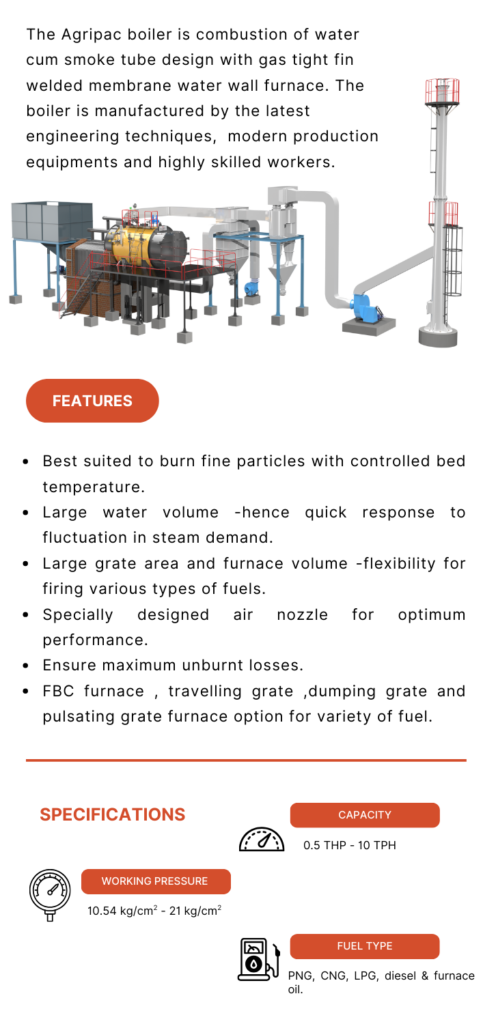
For facilities that need greater fuel flexibility, Maanya’s Biomax range suits biomass and multi-fuel applications, including fuels such as bagasse, rice husk and wood chips.
The right choice depends on the actual fuel supply and process requirements, not just the desired steam capacity.
Why Choose Maanya Boilers for Biomass Boiler Requirements?
Maanya Boilers manufactures industrial boiler systems for different capacities, pressures and fuel requirements. Its range includes Agripac, Agromax, Biomax, Combimac and other boiler configurations designed for different industrial applications.
For an industry evaluating a biomass boiler, the important consideration is not simply the boiler’s rated steam output. Fuel characteristics, steam conditions, operating hours, available fuel, ash management and expected load all need to be considered.
Maanya also offers IBR and other industrial boiler configurations to meet specific requirements, allowing the boiler solution to be evaluated against the plant’s operating and regulatory needs.
Conclusion
Biomass boiler fuel consumption depends on steam conditions, fuel quality, moisture and boiler efficiency rather than a fixed figure per tonne of steam. Accurate calculations should use tested fuel properties and actual operating data.
Choosing a biomass boiler designed for the available fuel can also improve consistency, efficiency and long-term operating control while helping industries manage steam-generation costs effectively.
Frequently Asked Questions
1. How much biomass fuel is needed to produce one tonne of steam?
There is no fixed amount. Consumption depends on steam pressure, feedwater temperature, fuel heating value, moisture and boiler efficiency.
2. Does steam pressure affect biomass fuel consumption?
Yes. Steam at different pressures requires different amounts of energy. Therefore, you must specify pressure when estimating fuel consumption.
3. Why is calorific value important in biomass fuel selection?
Calorific value indicates the energy available from the fuel. A lower heating value generally means you need more fuel to provide the same amount of useful heat.
4. What factors can increase biomass boiler fuel consumption?
High fuel moisture, lower heating value, poor combustion, unsuitable operating loads and heat losses can all increase the amount of biomass required.
5. How should biomass boiler fuel consumption be monitored?
Measure the biomass consumed and steam generated over the same period. Tracking fuel moisture, heating value, and steam conditions provides additional context.
No responses yet