

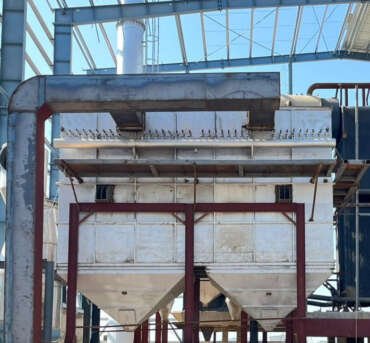
Case Study: Pulse Jet Bag Filter Performance in the Field
Introduction
Industrial development has transformed the way we live. From the electricity that powers our homes to the food we consume, the medicines we rely on, and the construction materials used to build our cities, almost every product around us is manufactured in an industrial facility. While industries play a vital role in economic growth, they also face an important responsibility—controlling the dust and particulate matter generated during manufacturing processes.
Many industrial operations such as biomass-fired boilers, rice mills, flour mills, cement plants, chemical factories, steel manufacturing units, food processing facilities, pharmaceuticals, paper mills, textile plants, and foundries generate significant amounts of dust. If this dust is released directly into the atmosphere, it can contribute to air pollution, reduce air quality, affect worker health, damage nearby equipment, contaminate products, and lead to non-compliance with environmental regulations.
This is why modern industries invest in Industrial Pulse Jet Bag Filters, one of the most efficient and widely used air pollution control systems for capturing fine particulate matter before it enters the atmosphere.
In simple terms, an Industrial Pulse Jet Bag Filter works much like the filter in a household vacuum cleaner—but on a much larger scale. Instead of trapping household dust, it captures fly ash, biomass ash, cement dust, wood particles, flour dust, chemical powders, and other airborne particles produced during industrial operations. Polluted air passes through specially designed fabric filter bags that trap dust while allowing clean air to pass through. A pulse of compressed air then cleans the bags automatically, enabling continuous operation without frequent shutdowns.
As environmental awareness grows and governments implement stricter emission standards, industries are increasingly adopting advanced dust collection systems to improve environmental performance and workplace safety. Installing an efficient bag filter is no longer just about regulatory compliance—it is also about improving operational efficiency, protecting valuable equipment, reducing maintenance costs, and supporting sustainable manufacturing practices.
At Maanya Boilers, we understand that no two industries are the same. Different fuels, operating temperatures, airflow requirements, and dust characteristics demand carefully engineered pollution control solutions. Our Industrial Pulse Jet Bag Filters are designed to provide reliable dust collection performance for a wide range of industrial applications, including biomass boilers and process industries.
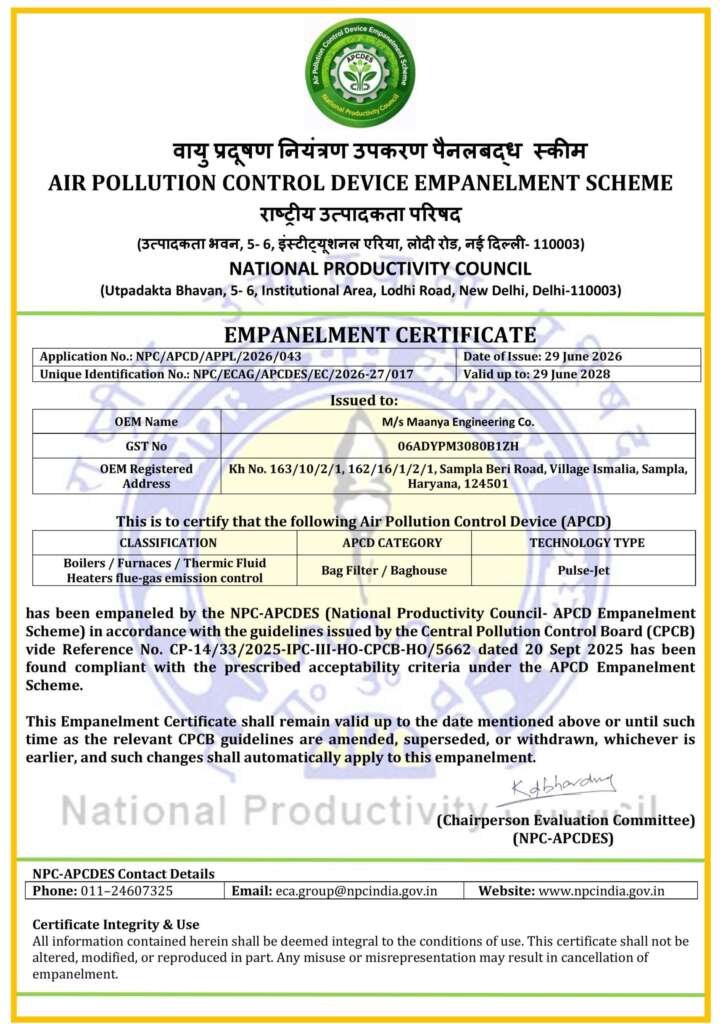
Adding to this commitment is our NPC-APCDES (National Productivity Council – Air Pollution Control Device Empanelment Scheme) Empanelment for Pulse-Jet Bag Filters (Baghouses). This recognition reflects that the evaluated equipment has met the prescribed technical and acceptance criteria under the scheme, giving customers additional confidence in the quality and engineering of our solutions.
Whether you are a plant owner looking to improve your emission control system, an engineer selecting the right dust collection technology, or someone simply trying to understand how industrial bag filters work, this guide has been written to answer your questions in clear, practical, and easy-to-understand language.
By the end of this article, you will understand:
- What an Industrial Pulse Jet Bag Filter is
- Why industries need bag filters
- How a pulse jet bag filter works
- The major components of a baghouse system
- Advantages and limitations of bag filters
- Industries that use industrial bag filters
- How Maanya Boilers designs and manufactures its bag filters
- The significance of our NPC-APCDES empanelment
- How bag filters compare with ESPs, wet scrubbers, cyclones, and other pollution control equipment
- Why the demand for industrial bag filters continues to grow in India and across the world
If you’re exploring complete air pollution control solutions, you can also learn more about Maanya Boilers’ Pollution Control Equipment here:
https://maanyaboilers.co.in/pollution-control-equipment/
Industries looking for integrated steam generation and emission control systems may also find our Biomass Boiler solutions useful:
https://maanyaboilers.co.in/biomass-boiler/
Quick Answer: What is an Industrial Pulse Jet Bag Filter?
An Industrial Pulse Jet Bag Filter is an air pollution control device that removes dust and fine particulate matter from industrial exhaust gases by passing polluted air through specially designed fabric filter bags. The dust remains trapped on the surface of the bags while clean air exits the system. Short bursts of compressed air periodically clean the bags, allowing the filter to operate continuously with high efficiency and minimal downtime.
Why This Guide Matters
Selecting the right pollution control equipment affects much more than regulatory compliance. A properly designed Industrial Pulse Jet Bag Filter can help industries:
- Improve workplace air quality
- Protect expensive process equipment
- Reduce environmental impact
- Extend equipment life
- Support cleaner production practices
- Improve operational efficiency
- Meet applicable emission norms
- Lower long-term maintenance costs
For readers who want to understand how Industrial Pulse Jet Bag Filters compare with Electrostatic Precipitators, we’ve also published a dedicated comparison guide:
https://maanyaboilers.co.in/bag-filter-vs-esp/
To learn more about environmental regulations and industrial air quality, you can also refer to the Central Pollution Control Board (CPCB):
https://cpcb.nic.in/
What is an Industrial Pulse Jet Bag Filter?
Imagine you’re cleaning your home using a vacuum cleaner. As the vacuum sucks in dusty air, the dirt gets trapped inside a filter bag while clean air is released back into the room. Although the machine looks simple, it performs an important task—it separates dust from air.
An Industrial Pulse Jet Bag Filter works on the same basic principle, but on a much larger scale. Instead of cleaning a living room, it cleans thousands of cubic metres of polluted air generated by industrial processes every hour.
Industries such as biomass power plants, rice mills, cement factories, chemical manufacturing units, steel plants, pharmaceuticals, food processing facilities, paper mills, and textile industries generate large amounts of airborne dust during production. If this dust is released directly into the atmosphere, it can contribute to air pollution, affect workers’ health, reduce equipment efficiency, and create environmental compliance issues.
An Industrial Pulse Jet Bag Filter is designed to prevent this from happening. It captures dust particles before they leave the chimney, allowing only clean air to be discharged into the environment.
Unlike simple filters that require frequent manual cleaning or replacement, a Pulse Jet Bag Filter continuously cleans itself using compressed air. This automatic cleaning mechanism allows industries to operate continuously with minimal downtime, making it one of the most efficient dust collection technologies available today.
For industries looking to improve their overall environmental performance, Industrial Pulse Jet Bag Filters are often installed as part of a complete Pollution Control Equipment system offered by Maanya Boilers.
Pollution Control Equipment
https://maanyaboilers.co.in/pollution-control-equipment/
Quick Definition : What is an Industrial Pulse Jet Bag Filter?
An Industrial Pulse Jet Bag Filter is an air pollution control device that removes dust and suspended particulate matter from industrial exhaust gases using specially designed fabric filter bags. Dust remains trapped on the surface of the filter bags while clean air passes through. Periodic bursts of compressed air clean the bags automatically, ensuring continuous and efficient operation.
Why Are Industrial Bag Filters So Important?
Many people think industrial smoke only contains visible black particles. In reality, a significant portion of industrial emissions consists of microscopic dust particles that cannot be seen with the naked eye.
These particles, often referred to as particulate matter (PM), can remain suspended in the air for long periods and may affect nearby communities, workers, machinery, and the surrounding environment if not properly controlled.
According to the Central Pollution Control Board (CPCB), industries are expected to adopt suitable air pollution control measures to reduce particulate emissions and help meet applicable environmental standards.
This is one of the reasons why Industrial Pulse Jet Bag Filters have become an essential part of modern industrial infrastructure.
Think of It Like This…
Imagine trying to make tea without using a tea strainer.
The tea leaves would mix with the tea, making it unpleasant to drink.
Now imagine replacing tea leaves with industrial dust.
Without a filtration system, that dust would travel through the chimney and be released into the atmosphere.
A Pulse Jet Bag Filter acts like an industrial-grade strainer—but instead of separating tea leaves, it separates fine dust particles from moving air.
The result is:
- Cleaner emissions
- Improved air quality
- Better workplace conditions
- Reduced dust accumulation
- Improved equipment reliability
- Better environmental performance
This simple principle has made fabric filtration one of the most trusted technologies in industrial air pollution control.
What Kind of Dust Can a Bag Filter Capture?
One of the biggest advantages of an Industrial Pulse Jet Bag Filter is its versatility.
Depending on the application and filter media selected, it can effectively capture a wide range of dry particulate matter, including:
- Fly ash from biomass boilers
- Rice husk ash
- Bagasse ash
- Wood dust
- Sawdust
- Flour dust
- Cement dust
- Lime dust
- Carbon black
- Fertilizer dust
- Chemical powders
- Pharmaceutical powders
- Mineral dust
- Foundry sand dust
- Metal grinding dust
- Grain processing dust
- Biomass combustion particles
- Fine particulate matter generated during industrial manufacturing
Different industries generate different types of dust. This is why selecting the correct filter bag material is just as important as selecting the right bag filter system. We will discuss filter bag materials in detail later in this guide.
How Does a Bag Filter Remove Dust?
At its core, the working principle is surprisingly simple.
The polluted air enters the bag filter housing through the inlet duct.
As the air passes through hundreds of specially designed fabric filter bags, the tiny openings within the fabric allow clean air to pass while trapping dust particles on the outer surface of the bags.
Over time, this layer of dust—often called a dust cake—actually helps improve filtration efficiency by capturing even finer particles.
However, if too much dust accumulates, airflow can become restricted.
To prevent this, the Pulse Jet cleaning system periodically releases a short burst of compressed air inside each filter bag. This sudden pulse expands the bag slightly, causing the accumulated dust cake to break away and fall into the hopper below.
The collected dust can then be removed safely through the discharge system for disposal or, in some applications, recovery and reuse.
This automatic cleaning process allows the bag filter to continue operating without stopping production.
Why Is It Called a “Pulse Jet” Bag Filter?
The name comes from its unique cleaning mechanism.
Unlike older bag filters that required manual shaking or reverse airflow, a Pulse Jet Bag Filter uses a very short pulse of compressed air to clean the filter bags.
This pulse typically lasts only a fraction of a second but is powerful enough to remove accumulated dust without damaging the filter media.
Because cleaning takes place while the system continues operating, industries benefit from:
- Continuous production
- Lower maintenance requirements
- Consistent airflow
- Improved dust collection efficiency
- Longer filter bag life (with proper operation and maintenance)
This is one of the key reasons why Pulse Jet Bag Filters have become the preferred choice for many modern industrial applications.
Why Do Industries Prefer Pulse Jet Bag Filters?
Compared with many conventional dust collection systems, Pulse Jet Bag Filters offer several operational advantages:
✔ High dust collection efficiency for fine dry particulate matter
✔ Automatic cleaning without interrupting production
✔ Suitable for a wide variety of industries
✔ Modular design for different plant capacities
✔ Lower manual maintenance compared with older filtration systems
✔ Adaptable to different filter bag materials based on temperature and dust characteristics
✔ Helps support cleaner workplace conditions and environmental compliance when properly designed and operated
Where Are Industrial Pulse Jet Bag Filters Commonly Used?
Because of their flexibility and efficiency, these systems are used in many industries, including:
- Biomass Boiler Plants
- Rice Mills
- Flour Mills
- Food Processing Units
- Sugar Industries
- Paper Mills
- Cement Plants
- Steel Manufacturing
- Chemical Industries
- Pharmaceutical Manufacturing
- Textile Processing
- Foundries
- Plywood Manufacturing
- Wood Processing Industries
- Grain Processing Plants
- Fertilizer Plants
- Ceramic Manufacturing
- Mineral Processing Units
At Maanya Boilers, Industrial Pulse Jet Bag Filters are engineered to integrate effectively with biomass boiler systems and other industrial applications, helping customers reduce particulate emissions while supporting efficient plant operations.
To understand how bag filters compare with Electrostatic Precipitators for different industrial applications, you can also explore our Bag Filter vs ESP comparison guide.
Blog Link:
Key Takeaways
An Industrial Pulse Jet Bag Filter is much more than a dust collector—it is a critical component of modern industrial pollution control. By capturing fine particulate matter before it is released into the atmosphere, these systems help industries improve air quality, protect equipment, support worker safety, and operate more responsibly.
Whether installed in a biomass boiler plant, food processing facility, chemical factory, or cement plant, a well-designed Pulse Jet Bag Filter contributes to cleaner operations, greater efficiency, and long-term environmental sustainability.
Why Do Industries Need Industrial Bag Filters?
Industrial pollution control is not only about stopping visible smoke from coming out of a chimney. A large part of industrial air pollution consists of extremely small particles of dust, ash, powder, soot, and other solid matter carried along with exhaust gases.
These particles can be generated during fuel combustion, material handling, grinding, crushing, mixing, drying, conveying, packaging, and manufacturing processes.
This creates a simple but important question:
Where does all this dust go if we don’t capture it?
Without an effective dust collection system, a portion of it may travel with the exhaust air and eventually enter the atmosphere.
An Industrial Pulse Jet Bag Filter provides a controlled method of separating particulate matter from industrial exhaust streams before discharge.
The need for bag filters can broadly be understood through five areas: environmental protection, worker health, regulatory compliance, equipment protection, and operational efficiency.
Industrial Dust Is More Than Just Visible Smoke
When we imagine industrial air pollution, we often picture thick black smoke coming from a factory chimney.
But pollution isn’t always visible.
Industrial exhaust can contain extremely small particles collectively known as particulate matter (PM).
Two commonly discussed categories are:
PM10 — particles with aerodynamic diameters of 10 micrometres or smaller.
PM2.5 — particles with aerodynamic diameters of 2.5 micrometres or smaller.
For perspective, the diameter of a human hair is many times larger than a PM2.5 particle.
The World Health Organization (WHO) identifies particulate matter as an important air pollutant because smaller particles can penetrate deeply into the respiratory system, with PM2.5 capable of reaching the lungs and entering the bloodstream.
For more information about particulate matter and its health effects, readers can refer to the World Health Organization’s Air Quality guidance.
This is why simply looking at a chimney and thinking,
“There isn’t much smoke, so the emissions must be clean.”
isn’t necessarily correct.
Effective pollution control requires capturing particulate matter—not simply reducing what we can see.
Why Can’t Industries Simply Release Dust Through the Chimney?
Consider a biomass boiler operating continuously throughout the day.
The boiler may burn fuels such as:
- Rice husk
- Paddy straw
- Bagasse
- Biomass briquettes
- Agricultural residues
- Wood-based biomass
- Other suitable biomass fuels
When these fuels burn, they generate heat—but combustion can also produce ash and fine particulate matter.
Hot exhaust gases carry some of these particles away from the combustion chamber.
If appropriate pollution control equipment isn’t installed downstream, these particles may eventually leave through the stack.
The chimney itself doesn’t clean the exhaust gas.
It provides a route for exhaust gases to leave the plant.
Therefore, industries require suitable Air Pollution Control Devices (APCDs) to separate pollutants from the gas stream before discharge.
A bag filter is one such technology.
You can explore the different Pollution Control Equipment solutions offered by Maanya Boilers alongside its boiler systems for a broader understanding of industrial emission-control options.
Explore Maanya Boilers Pollution Control Equipment
Reason #1: To Reduce Particulate Emissions
The first and most obvious reason industries install bag filters is to capture particulate matter before it reaches the atmosphere.
Imagine a rice processing plant.
Rice arrives at the facility and passes through multiple stages of processing.
During operations such as:
Handling → Cleaning → Processing → Conveying → Storage → Packaging
dust can be generated at several points.
Now add a biomass boiler producing steam for the manufacturing process.
The plant potentially has two different sources of dust:
- Dust generated through material handling and processing.
- Fly ash and particulate matter associated with combustion.
A properly designed dust collection system can capture particulate matter from applicable process streams instead of allowing it to spread throughout the facility or escape into the surrounding environment.
This makes Industrial Pulse Jet Bag Filters valuable not only for boilers but for many dust-generating processes throughout manufacturing facilities.
Reason #2: To Support Cleaner Air Around Industrial Facilities
Factories don’t operate in isolation.
Industrial plants may be located near:
- Villages
- Agricultural land
- Residential areas
- Highways
- Commercial areas
- Other factories
- Warehouses
- Schools
- Farms
Uncontrolled dust can settle on nearby buildings, vehicles, machinery, vegetation, roads, and other surfaces.
Fine particles can also remain suspended in the atmosphere.
Installing appropriate industrial dust collection systems helps prevent a substantial portion of this particulate matter from being released from controlled emission sources in the first place.
Instead of:
Dust Generation → Chimney → Atmosphere
the process becomes:
Dust Generation → Collection System → Filtration → Dust Recovery → Cleaner Exhaust
That additional filtration stage can make a major difference.
Reason #3: To Improve Workplace Conditions
Pollution control isn’t only about what happens outside the factory.
It matters inside the factory as well.
Imagine employees working eight-hour shifts in an environment where fine dust continuously settles on:
- Floors
- Workstations
- Machines
- Electrical panels
- Storage areas
- Finished products
Besides creating housekeeping problems, excessive airborne dust can contribute to poor workplace air quality and, depending on the material, occupational exposure concerns.
Capturing dust close to where it is generated can help create cleaner working conditions.
For certain manufacturing processes, this is one of the most important reasons to invest in a properly engineered industrial dust collection system.
Reason #4: To Protect Expensive Industrial Equipment
Industrial machinery represents a major investment.
Motors, bearings, blowers, electrical equipment, conveyors, sensors, and control systems are designed to operate under specified conditions.
Fine dust can find its way into extremely small spaces.
Over time, excessive dust accumulation can contribute to:
- Clogged ventilation systems
- Contaminated equipment surfaces
- Increased cleaning requirements
- Reduced cooling effectiveness
- Wear of moving components
- Additional maintenance
- Unexpected shutdowns
The consequences aren’t always immediate.
Instead, equipment deterioration can happen gradually.
Reason #5: To Support Environmental Compliance
Industries cannot decide independently how much particulate matter they want to release.
Industrial facilities operate within applicable environmental regulations, consent conditions, and emission standards depending on their industry, equipment, fuel, location, and jurisdiction.
In India, the Central Pollution Control Board (CPCB) operates under the Ministry of Environment, Forest and Climate Change and performs functions related to pollution prevention and control, alongside State Pollution Control Boards and Pollution Control Committees.
Industries can refer to official regulations, standards, technical documents, and updates through the Central Pollution Control Board official website and the Ministry of Environment, Forest and Climate Change.
A properly selected and operated bag filter can form part of an industry’s strategy for controlling particulate emissions and meeting the requirements applicable to its facility.
It is important to understand, however, that installing a bag filter does not automatically guarantee regulatory compliance.
Performance depends upon correct:
Design + Selection + Installation + Operation + Maintenance
All five matter.
Reason #6: To Handle Biomass Boiler Fly Ash
This is particularly relevant for industries moving towards biomass fuels.
Biomass fuels can provide industries with an alternative to conventional fossil-fuel-based steam generation, particularly where agricultural residues are locally available and technically suitable.
But burning biomass doesn’t mean pollution control is unnecessary.
Quite the opposite.
Combustion can produce ash and particulate matter that needs to be appropriately managed.
Consider fuels such as:
Rice Husk → Paddy Straw → Bagasse → Biomass Briquettes → Agricultural Residues
Their ash characteristics can differ substantially.
Particle size, moisture, ash chemistry, temperature, and quantity can vary depending on the fuel and operating conditions.
Therefore, the pollution control system needs to be selected accordingly.
Readers interested in biomass-fired steam generation can learn more about Maanya Boilers’ Biomass Boiler solutions.
This relationship between biomass combustion + appropriate emission control is becoming increasingly important as industries explore cleaner and more resource-efficient manufacturing strategies.
Reason #7: To Recover Valuable Material Instead of Wasting It
Here’s an advantage of industrial dust collection that is sometimes overlooked.
The material captured by a bag filter doesn’t simply disappear.
It collects inside the hopper.
Depending on what the captured material contains—and subject to its composition, safety, quality requirements, and applicable regulations—it may sometimes be:
Recovered → Reprocessed → Recycled → Reused → Safely disposed
For example, some manufacturing processes generate valuable powdered materials that become airborne during production.
If those particles escape through the ventilation system, the manufacturer isn’t only creating pollution.
They’re potentially losing usable material.
Capturing it can therefore have both environmental and economic benefits where recovery is technically feasible.
Reason #8: Better Product Quality and Reduced Contamination
Suppose you manufacture food products.
Would you want dust from one manufacturing stage settling onto another production line?
Probably not.
The same problem can occur in:
- Food processing
- Pharmaceuticals
- Chemicals
- Minerals
- Grain processing
- Flour mills
- Fertilizer manufacturing
- Powder processing
Uncontrolled airborne material can move from one section of a factory to another.
Proper dust extraction can therefore help maintain cleaner production environments and reduce the potential for unwanted contamination, depending on the process design.
Reason #9: Cleaner Factories Require Less Housekeeping
There’s also a straightforward operational benefit.
Less escaped dust means less dust to clean.
Factories without effective dust control may require frequent:
- Floor cleaning
- Machine cleaning
- Wall cleaning
- Duct cleaning
- Equipment cleaning
- Workplace housekeeping
Every hour employees spend repeatedly cleaning avoidable dust represents labour and operational resources.
Rather than continuously cleaning dust after it spreads, effective dust collection aims to capture it before it spreads.
That is a much more efficient approach.
Reason #10: Supporting Sustainable Manufacturing and ESG Goals
Modern industrial buyers increasingly evaluate suppliers on more than price and production capacity.
Environmental performance has become an important consideration across global supply chains.
Companies are increasingly tracking areas such as:
- Energy efficiency
- Resource efficiency
- Air emissions
- Waste reduction
- Water consumption
- Worker safety
- Environmental impact
These considerations form part of broader Environmental, Social and Governance (ESG) strategies adopted by many businesses.
Air pollution control technologies such as Industrial Pulse Jet Bag Filters can support the environmental component of these strategies by helping facilities manage particulate emissions from applicable processes.
What Happens When Industrial Dust Isn’t Controlled?
The easiest way to understand the importance of bag filters is to consider the alternative.
Without adequate dust control, an industrial facility may experience a combination of:
Higher particulate emissions → Dustier workplaces → Greater housekeeping → Equipment contamination → Material losses → Environmental concerns → Compliance challenges
These problems can eventually translate into higher operational costs.
Preventing pollution at the source is generally more effective than attempting to deal with its consequences afterward.
Does Every Industry Need a Bag Filter?
Not necessarily.
This distinction is important.
A Bag Filter isn’t automatically the best pollution control technology for every pollutant, process, or industrial application.
The correct solution depends on factors including:
- Pollutant type
- Dust characteristics
- Particle size
- Gas temperature
- Moisture
- Gas volume
- Chemical composition
- Required emission performance
- Fuel characteristics
- Process conditions
- Available installation space
- Maintenance capabilities
- Regulatory requirements
For example, some applications may benefit from a Cyclone Separator, while others may require an Electrostatic Precipitator (ESP), Wet Scrubber, Bag Filter, Multicyclone, or a combination of technologies.
This is why pollution control equipment should be engineered around the application rather than selected simply because one technology is popular.
For readers deciding between fabric filtration and electrostatic precipitation, our separate Bag Filter vs ESP comparison guide examines these technologies in greater depth without repeating that comparison here.
Why Proper Bag Filter Design Matters
Buying a bag filter isn’t like buying an air purifier for your bedroom.
You cannot simply say:
“Give me a big bag filter.”
The system needs to be engineered according to actual plant conditions.
Engineers may need to consider variables such as:
Gas Volume → Temperature → Dust Loading → Particle Characteristics → Filter Media → Filtration Velocity → Pressure Drop → Cleaning System → Hopper Design → Dust Discharge
If one of these parameters is incorrectly selected, the entire system’s performance can suffer.
For example, using inappropriate filter media for the operating temperature could shorten filter bag life.
Similarly, poor airflow distribution may cause some bags to receive substantially greater dust loading than others.
This is why engineering and system design matter just as much as manufacturing quality.
Quick Answer: Why Are Industrial Bag Filters Needed?
Industrial bag filters are used to capture dust and particulate matter from industrial exhaust gases before those particles are released into the atmosphere. They can help reduce particulate emissions, improve workplace cleanliness, protect equipment, reduce material losses, support applicable environmental compliance, and contribute to cleaner and more sustainable industrial operations.
Key Takeaway
An Industrial Pulse Jet Bag Filter isn’t simply an accessory attached to a boiler or factory exhaust system.
When the application calls for fabric filtration, it becomes part of the plant’s overall pollution-control infrastructure.
Its purpose can be summarised simply:
Capture pollution before it becomes pollution outside the process.
By controlling dust closer to its source, industries can protect their employees, machinery, production environment, surrounding communities, and long-term operations simultaneously.
And the effectiveness of that protection depends heavily on how the Bag Filter actually captures, separates, cleans, and removes those particles—which brings us to its working principle.
How Does an Industrial Pulse Jet Bag Filter Work?
One of the most common questions engineers, factory owners, students, and purchase managers ask is:
“How does an Industrial Pulse Jet Bag Filter actually work?”
The answer is surprisingly simple.
An Industrial Pulse Jet Bag Filter works by separating dust particles from polluted air using specially designed fabric filter bags. Dust remains trapped on the outer surface of these bags while clean air passes through the fabric and exits the system. As dust builds up, an automatic pulse of compressed air cleans the bags, allowing the filter to continue operating without stopping production.
Although the principle is straightforward, several engineered components work together to make the system efficient, reliable, and suitable for continuous industrial operation.
Quick Answer: How Does a Pulse Jet Bag Filter Work?
An Industrial Pulse Jet Bag Filter cleans polluted industrial air in seven main stages:
- Dust-laden gas enters the bag filter.
- Air is evenly distributed inside the housing.
- Dust particles are trapped on the filter bags.
- Clean air passes through the fabric.
- Dust accumulates on the outer surface of the bags.
- Compressed air pulses automatically clean the bags.
- Dust falls into the hopper for collection while clean air exits through the stack.
Because cleaning occurs automatically, production usually continues without interrupting plant operations.
Understanding the Working Principle in Simple Language
Imagine you’re making tea.
When you pour tea through a strainer:
- The liquid passes through.
- The tea leaves remain behind.
A Pulse Jet Bag Filter works similarly.
Instead of separating tea leaves from tea, it separates dust from air.
The difference is that an industrial bag filter performs this process continuously while handling thousands of cubic metres of exhaust gas every hour.
Step 1: Polluted Air Enters the Bag Filter
Every industrial process generates some amount of airborne particulate matter.
For example:
- A biomass boiler produces fly ash.
- A flour mill generates flour dust.
- A cement plant creates cement particles.
- A foundry releases metal dust.
- A woodworking unit generates sawdust.
These particles become mixed with the exhaust gases.
Instead of releasing this polluted gas directly into the atmosphere, it is routed into the Industrial Pulse Jet Bag Filter through an inlet duct.
At this stage, the air still contains dust.
Nothing has been filtered yet.
Example
Imagine blowing dust across a room.
The dust moves wherever the air moves.
Inside a factory, the same thing happens—but on a much larger scale.
The polluted air simply follows the airflow into the filtration system.
Step 2: Air Distribution Inside the Bag Filter
Once the polluted air enters the housing, it cannot simply rush directly toward the outlet.
If it did:
- Some filter bags would receive excessive dust.
- Others would receive very little.
- Filtration efficiency would decrease.
- Bag life could be reduced.
Therefore, the housing is designed to distribute airflow as evenly as possible across all filter bags.
This allows every filter bag to participate in the filtration process.
Proper airflow distribution is one of the reasons why engineering and system design are just as important as manufacturing quality.
At Maanya Boilers, airflow patterns, gas volume, and process requirements are considered during the design stage to help ensure efficient dust collection for different industrial applications.
Step 3: Dust Particles Reach the Filter Bags
Now comes the most important stage.
Inside the bag filter housing are multiple cylindrical fabric bags supported by metal cages.
Depending on the plant capacity, there may be:
- Dozens of bags
- Hundreds of bags
- Or even thousands of bags in large industrial baghouses.
As the polluted air flows around these bags, it is forced to pass through the fabric.
The fabric contains microscopic openings.
These openings are:
- Large enough for clean air molecules to pass through.
- Small enough to trap dust particles.
This is where filtration begins.
Step 4: Clean Air Passes Through the Fabric
As the air continues moving through the filter bags:
✔ Clean air passes through the fabric.
✔ Dust remains outside.
The filtered air then enters the clean air chamber before being discharged through the outlet duct and chimney.
At this point, most of the particulate matter has been separated from the airflow.
Only the cleaned gas continues toward the stack.
This simple process is why fabric filtration is recognised as one of the most effective methods for controlling dry particulate emissions in many industrial applications.
Step 5: Dust Cake Formation – Why More Dust Can Improve Filtration
This surprises many people.
You might assume that dust collecting on the filter bags is a bad thing.
Actually, a thin layer of dust—known as the dust cake—often helps improve filtration.
Here’s why.
Once the first layer of dust settles on the fabric, incoming particles are trapped not only by the fabric itself but also by the existing dust layer.
Think about walking on fresh snow.
The first footprints create a path.
As more people walk, that path becomes more defined.
Similarly, the dust cake becomes an additional filtering layer.
This can increase filtration efficiency for very fine particles.
However, there is a limit.
If the dust cake becomes too thick:
- Airflow decreases.
- Pressure increases.
- Fan power may increase.
- System performance can decline.
That is why automatic cleaning is essential.
Step 6: Pulse Jet Cleaning – The Heart of the System
This is what makes a Pulse Jet Bag Filter different from older filtration technologies.
Instead of stopping production for cleaning, the system cleans itself automatically.
At regular intervals—or based on differential pressure—a control system activates a solenoid valve.
The valve releases a very short burst of compressed air through a blow pipe into the filter bag.
The pulse typically lasts only a fraction of a second.
Yet it is powerful enough to:
- Expand the filter bag slightly.
- Break the dust cake.
- Shake loose accumulated particles.
- Restore airflow through the fabric.
The dust falls into the hopper below while filtration continues.
No production shutdown is required.
This automatic cleaning process is one of the main reasons Pulse Jet Bag Filters are widely used in modern industries.
Step 7: Dust Collection in the Hopper
Once the dust is removed from the filter bags, gravity takes over.
The dust falls into the hopper located at the bottom of the bag filter.
From there, it may be discharged using equipment such as:
- Rotary Air Lock Valves
- Screw Conveyors
- Manual Collection Systems
- Pneumatic Conveying Systems
The method depends on the application and plant design.
In some industries, collected dust may be safely disposed of.
In others, suitable material may be recovered and reused as part of the manufacturing process.
What Controls the Cleaning Cycle?
A common misconception is that the bag filter continuously blows compressed air.
It doesn’t.
Cleaning occurs only when required.
Modern systems generally use one of the following methods:
1. Timer-Based Cleaning
Compressed air pulses are released at fixed time intervals.
Simple and reliable for many applications.
2. Differential Pressure-Based Cleaning
This is often considered more efficient.
As dust accumulates, the resistance to airflow increases.
This resistance is measured as differential pressure (ΔP) across the filter bags.
When the pressure reaches a predetermined level, the controller activates pulse cleaning.
This helps maintain stable airflow while avoiding unnecessary compressed air consumption.
Why Doesn’t the Filter Bag Tear During Cleaning?
People often ask:
“If compressed air is blasted into the bag, won’t it burst?”
The answer is no—provided the system is correctly designed and operated.
Each filter bag is supported by a steel cage.
The cage:
- Maintains the bag’s shape.
- Prevents collapse.
- Supports expansion during pulse cleaning.
- Helps distribute stresses more evenly.
Proper selection of filter media, pulse pressure, cleaning frequency, and operating conditions all contribute to reliable bag life.
What Happens to the Clean Air?
Once filtration is complete:
- Dust remains inside the baghouse.
- Cleaned gas enters the clean-air plenum.
- The induced draft (ID) fan draws the cleaned air through the outlet.
- The filtered exhaust is discharged through the stack.
The objective is to significantly reduce the amount of particulate matter released from the controlled process.
Common Factors That Affect Bag Filter Performance
Even the best bag filter can perform poorly if it is not designed for the application.
Important factors include:
- Gas temperature
- Dust characteristics
- Air-to-cloth ratio
- Filter media selection
- Moisture content
- Particle size
- Dust loading
- Compressed air quality
- Differential pressure settings
- Preventive maintenance
This is why selecting the right system is more important than simply choosing the largest one.
Why Engineering Matters
Every industrial application is different.
A biomass boiler burning rice husk produces different ash than a pharmaceutical plant handling fine powders or a woodworking unit processing timber.
The bag filter must therefore be engineered for:
- Fuel type
- Process conditions
- Gas volume
- Dust concentration
- Operating temperature
- Plant layout
- Maintenance accessibility
At Maanya Boilers, our engineering team designs Industrial Pulse Jet Bag Filters to suit the customer’s specific process rather than offering a one-size-fits-all solution. If you’re exploring complete emission-control systems, you can also visit our Pollution Control Equipment page:
https://maanyaboilers.co.in/pollution-control-equipment/
Summary: How Does an Industrial Pulse Jet Bag Filter Work?
The working process can be summarised in one simple flow:
Dust-Loaded Air
        │
        ▼
 Inlet Duct
        │
        ▼
 Air Distribution Chamber
        │
        ▼
 Fabric Filter Bags
        │
        ▼
 Dust Trapped on Bag Surface
        │
        ▼
 Clean Air Passes Through
        │
        ▼
 Pulse Jet Cleaning
        │
        ▼
 Dust Falls into Hopper
        │
        ▼
 Dust Collection & Disposal/Recovery
        │
        ▼
 Clean Air Released Through Stack
Key Takeaway
An Industrial Pulse Jet Bag Filter is more than just a dust collector—it’s an engineered filtration system that combines airflow management, fabric filtration, automatic pulse cleaning, and dust collection into one continuous process. When correctly designed, installed, and maintained, it can provide efficient particulate control while supporting cleaner operations, improved equipment reliability, and better environmental performance.
Main Components of an Industrial Pulse Jet Bag Filter
A well-designed Industrial Pulse Jet Bag Filter is much more than a steel chamber with fabric bags inside. It is a carefully engineered system where each component performs a specific function to ensure efficient dust collection, smooth airflow, and long-term reliability.
Think of it like the human body.
Just as the heart, lungs, brain, and muscles all work together to keep us alive, every part of a bag filter has a unique role in keeping the pollution control system operating efficiently.
If even one critical component is incorrectly designed, damaged, or poorly maintained, the overall performance of the system can be affected.
Let’s understand each component in simple language.
1. Bag Filter Housing (The Main Body)
The housing is the outer steel enclosure of the bag filter.
It acts like the protective shell that contains the entire filtration process.
Inside this housing are:
- Filter Bags
- Bag Cages
- Hopper
- Pulse Jet Cleaning System
- Air Distribution Chamber
- Clean Air Chamber
The housing must be strong enough to withstand:
- Continuous industrial operation
- Temperature variations
- Air pressure differences
- Dust loading
- Vibrations
Since industries operate under different environmental conditions, the housing is generally manufactured using heavy-duty steel and protected with suitable surface coatings to improve durability.
At Maanya Boilers, the housing is designed according to the customer’s airflow requirements, operating conditions, and plant layout rather than using a one-size-fits-all design.
2. Inlet Duct
The Inlet Duct is where the polluted air enters the bag filter.
Think of it as the entrance door.
Its job isn’t simply to bring dirty air inside.
It must also help distribute the airflow in a controlled manner.
If the inlet design is poor:
- Dust may hit some bags directly.
- Certain bags may wear faster.
- Air distribution becomes uneven.
- Filtration efficiency decreases.
This is why proper inlet design is an important part of bag filter engineering.
3. Air Distribution Chamber
Once the polluted gas enters the system, it first reaches the Air Distribution Chamber.
This section slows down and spreads the airflow evenly across the filter bags.
Imagine watering a garden.
If all the water flows to one plant, the others receive very little.
The same principle applies inside a bag filter.
The Air Distribution Chamber ensures that all filter bags receive a balanced airflow, helping improve dust collection efficiency and extend filter bag life.
4. Filter Bags – The Heart of the System
The Filter Bags are the most important component of an Industrial Pulse Jet Bag Filter.
Without them, filtration simply cannot happen.
These specially engineered fabric bags trap dust particles while allowing clean air to pass through.
Depending on the application, filter bags may be manufactured using materials such as:
- Polyester
- PPS (Polyphenylene Sulfide)
- Nomex (Aramid)
- PTFE (Teflon)
- Fiberglass
- Acrylic
- Polypropylene
The correct filter media depends on several factors, including:
- Operating temperature
- Moisture content
- Chemical composition of the gas
- Dust characteristics
- Abrasion levels
- Process requirements
Choosing the wrong filter media can reduce filtration efficiency and shorten bag life, which is why proper engineering selection is essential.
We’ll explore filter media in greater detail later in this guide.
5. Bag Cages – The Support System
If you removed the steel cage from inside a filter bag, the bag would collapse under airflow.
This is why every filter bag is supported by a Bag Cage.
A bag cage is a steel framework placed inside the fabric bag.
Its job is to:
- Maintain the bag’s shape
- Prevent collapse
- Support the fabric during pulse cleaning
- Improve airflow
- Reduce stress on the filter media
Think of the bag cage as the skeleton of the filter bag.
Just as our bones support our body, the bag cage supports the filter bag.
6. Tube Sheet
The Tube Sheet is a thick steel plate located near the top of the bag filter.
It serves two important purposes:
- It securely holds all the filter bags in place.
- It separates the dirty air chamber from the clean air chamber.
Each filter bag is mounted through precisely machined holes in the tube sheet.
Proper sealing is critical because even a small air leak can allow dust to bypass the filtration system.
7. Clean Air Chamber
After passing through the filter bags, the cleaned air enters the Clean Air Chamber.
At this stage, most of the particulate matter has already been removed.
The clean air chamber acts as a collection area before the air moves toward the outlet duct and chimney.
Keeping this chamber free from dust leakage is essential for maintaining filtration performance.
8. Pulse Jet Cleaning System
One of the biggest advantages of a Pulse Jet Bag Filter is its automatic cleaning mechanism.
The Pulse Jet Cleaning System includes:
- Compressed Air Header
- Blow Pipes
- Solenoid Valves
- Pulse Valves
- Timer or PLC Controller
Together, these components release short bursts of compressed air that clean the filter bags without stopping production.
This automatic cleaning system allows industries to operate continuously while maintaining consistent airflow.
9. Compressed Air Header
The Compressed Air Header acts as a storage manifold for compressed air.
Instead of supplying air directly to each filter bag, the header distributes compressed air evenly throughout the pulse cleaning system.
This ensures that every cleaning pulse has sufficient pressure.
10. Blow Pipe
The Blow Pipe sits directly above the filter bags.
Small nozzles are positioned above each bag.
When pulse cleaning is activated, compressed air travels through the blow pipe and enters the corresponding filter bag.
The sudden expansion removes accumulated dust from the outer surface.
11. Solenoid Valve
The Solenoid Valve acts like an automatic switch.
It opens and closes in response to signals from the control system.
When activated, it allows compressed air to flow toward the pulse valve.
Modern bag filters use multiple solenoid valves to clean different rows of filter bags one after another.
12. Pulse Valve
The Pulse Valve is responsible for releasing the high-pressure burst of compressed air.
Although the pulse lasts only a fraction of a second, it provides enough force to dislodge accumulated dust without damaging the filter media.
13. Hopper – Where Dust Is Collected
The Hopper is located at the bottom of the bag filter.
After pulse cleaning, gravity causes the loosened dust to fall into this section.
The hopper temporarily stores the collected dust until it is discharged.
A properly designed hopper prevents dust accumulation and supports smooth material removal.
14. Rotary Air Lock Valve
Once dust reaches the hopper, it must be removed without allowing unwanted air leakage.
This is the job of the Rotary Air Lock Valve.
It continuously discharges collected dust while maintaining the pressure balance inside the system.
Without an air lock valve, uncontrolled air entry could reduce filtration efficiency.
16. Differential Pressure Gauge
One of the most important monitoring devices in a bag filter is the Differential Pressure (ΔP) Gauge.
This instrument measures the pressure difference between the dirty air chamber and the clean air chamber.
Why is this important?
If the pressure difference becomes too high, it may indicate:
- Excessive dust accumulation
- Blocked filter bags
- Cleaning issues
- Reduced airflow
If the pressure is too low, it could indicate:
- Damaged filter bags
- Air leakage
- Improper installation
Monitoring differential pressure helps operators determine when cleaning is required and assists in preventive maintenance.
17. Access Doors
Routine inspection and maintenance are essential for long-term performance.
Access Doors allow maintenance personnel to:
- Inspect filter bags
- Replace damaged bags
- Check bag cages
- Clean internal components
- Perform routine servicing safely
Proper sealing of access doors is important to prevent dust leakage.
18. Outlet Duct and Chimney
After filtration is complete, the cleaned air exits through the Outlet Duct and is discharged through the chimney.
By this stage, the air has already passed through the filtration process.
The chimney itself does not remove dust—it simply releases the cleaned exhaust gases after filtration.
How All Components Work Together
Here’s a simplified overview of the complete process:
Dirty Air
     │
     ▼
Inlet Duct
     │
     ▼
Air Distribution Chamber
     │
     ▼
Filter Bags + Bag Cages
     │
     ▼
Clean Air Chamber
     │
     ▼
Outlet Duct
     │
     ▼
Stack

          ▲
          │
Pulse Cleaning System
          │
Compressed Air Header
          │
Blow Pipe
          │
Pulse Valve
          │
Solenoid Valve

Dust
 │
 ▼
Hopper
 │
 ▼
Rotary Air Lock Valve
 │
 ▼
Dust Collection
Why Component Quality Matters
A bag filter performs only as well as the quality of its individual components.
For example:
- High-quality filter media can improve filtration performance and service life.
- Precision-engineered bag cages help prevent premature fabric wear.
- Properly designed hoppers reduce dust build-up.
- Reliable pulse valves ensure effective cleaning cycles.
- Well-balanced airflow improves overall efficiency.
This is why choosing an experienced manufacturer is just as important as choosing the right technology.
At Maanya Boilers, every Industrial Pulse Jet Bag Filter is engineered with attention to airflow distribution, structural integrity, component compatibility, and ease of maintenance. Our goal is to provide reliable pollution control solutions tailored to each customer’s process requirements. To learn more about our engineering approach, you can explore our About Us and Pollution Control Equipment pages, and if you’re interested in how our bag filters compare with other technologies, our Bag Filter vs ESP guide provides a detailed comparison.
Quick Recap
Every Industrial Pulse Jet Bag Filter consists of several critical components working together:
- Housing – Protects and contains the filtration system.
- Inlet Duct – Brings polluted air into the system.
- Air Distribution Chamber – Ensures balanced airflow.
- Filter Bags – Capture dust particles.
- Bag Cages – Support the filter bags.
- Tube Sheet – Separates dirty and clean air chambers.
- Pulse Jet Cleaning System – Automatically cleans the bags.
- Compressed Air Header & Blow Pipe – Deliver cleaning air.
- Pulse and Solenoid Valves – Control cleaning cycles.
- Hopper – Collects dust.
- Rotary Air Lock Valve – Removes dust while maintaining pressure.
- Differential Pressure Gauge – Monitors system health.
- Outlet Duct – Releases cleaned air.
Advantages and Limitations of Industrial Pulse Jet Bag Filters
When industries invest in an air pollution control system, one of the biggest questions they ask is:
“Is a Pulse Jet Bag Filter the right solution for my plant?”
The answer depends on several factors, including the type of dust, process temperature, gas composition, moisture levels, and production requirements.
Industrial Pulse Jet Bag Filters are among the most widely used air pollution control equipment because they offer high dust collection efficiency, automatic cleaning, and adaptability across many industries. However, like any engineering system, they also have certain limitations that should be understood before making a decision.
Knowing both the strengths and limitations helps industries select the most suitable pollution control solution instead of choosing equipment based only on initial cost or popularity.
Quick Answer: What Are the Advantages of an Industrial Pulse Jet Bag Filter?
An Industrial Pulse Jet Bag Filter offers several advantages, including high dust collection efficiency, automatic pulse cleaning, continuous operation, versatility across industries, improved workplace cleanliness, and support for environmental compliance. When properly designed and maintained, it can help industries reduce particulate emissions while improving operational efficiency.
High Dust Collection Efficiency
One of the biggest reasons industries choose a Pulse Jet Bag Filter is its ability to capture fine dry particulate matter.
Unlike simple dust separators that mainly remove larger particles, fabric filter bags are capable of trapping very fine dust generated during industrial processes.
This makes them suitable for applications such as:
- Biomass boilers
- Rice mills
- Cement plants
- Food processing
- Pharmaceuticals
- Chemical manufacturing
- Steel industries
- Mineral processing
Because dust is captured directly on the filter media, Pulse Jet Bag Filters can achieve very high particulate removal efficiencies when correctly designed for the application.
This is one reason they are commonly used where strict emission control is important.
Continuous Operation Without Production Shutdown
Older dust collection systems often required manual cleaning or periodic shutdowns.
Modern Pulse Jet Bag Filters solve this problem through automatic pulse cleaning.
Instead of stopping production, compressed air periodically cleans the filter bags while the system continues operating.
For industries that run continuously—such as biomass boiler plants, rice mills, or paper mills—this is a major advantage.
Continuous operation means:
- Less downtime
- Higher productivity
- Stable airflow
- Consistent filtration performance
Automatic Cleaning Reduces Manual Maintenance
No industrial equipment is maintenance-free.
However, Pulse Jet Bag Filters significantly reduce the need for manual cleaning compared to older technologies.
The automatic pulse cleaning system continuously removes accumulated dust from the filter bags, helping maintain airflow without requiring operators to stop production for routine dust removal.
This allows maintenance teams to focus on inspections and preventive maintenance rather than frequent manual cleaning.
Suitable for a Wide Range of Industries
One reason Industrial Pulse Jet Bag Filters are so popular is their versatility.
They are used across industries including:
- Biomass Boiler Plants
- Rice Mills
- Flour Mills
- Food Processing
- Sugar Industries
- Paper Mills
- Cement Manufacturing
- Steel Plants
- Textile Industries
- Chemical Processing
- Pharmaceutical Manufacturing
- Plywood Industry
- Wood Processing
- Grain Processing
- Foundries
- Fertilizer Plants
- Ceramic Manufacturing
Since every process generates different types of dust, the filter media and system design can be customized accordingly.
At Maanya Boilers, we design pollution control solutions based on each customer’s operating conditions rather than using a standard configuration for every application.
You can also explore the industries we serve here:
Suggested Internal Link
Industries We Serve
Better Workplace Cleanliness
Dust doesn’t only leave through chimneys.
It also settles on:
- Machines
- Floors
- Electrical panels
- Production equipment
- Finished products
- Walkways
Excessive dust accumulation increases housekeeping requirements and can make maintenance more challenging.
By capturing dust closer to the source, an Industrial Pulse Jet Bag Filter helps reduce airborne particulate matter within the process, contributing to a cleaner working environment.
Supports Environmental Compliance
Industrial facilities are expected to comply with applicable environmental regulations established by the relevant authorities.
A properly engineered and maintained bag filter can form part of an industry’s strategy for controlling particulate emissions.
However, it’s important to understand that compliance depends on:
- Proper system selection
- Correct installation
- Appropriate operation
- Regular maintenance
- Monitoring
Industries should always consult applicable requirements issued by authorities such as the Central Pollution Control Board (CPCB) and their respective State Pollution Control Boards.
Long Service Life When Properly Maintained
Industrial equipment represents a long-term investment.
With proper:
- Design
- Filter media selection
- Operating conditions
- Preventive maintenance
- Timely bag replacement
a Pulse Jet Bag Filter can provide reliable service over many years.
Regular inspection of:
- Filter bags
- Pulse valves
- Solenoid valves
- Rotary air lock valves
- Differential pressure
- Compressed air quality
helps maintain system performance.
Lower Material Loss
Some industries handle valuable powdered materials.
Without proper dust collection, these materials may become airborne and leave the process.
Capturing dust inside the hopper provides opportunities—where technically and economically feasible—for recovery or controlled disposal rather than allowing valuable material to escape.
Adaptable to Different Filter Media
Not every industrial process operates under the same conditions.
Some applications involve:
- High temperatures
- Abrasive dust
- Moisture
- Chemicals
- Sticky particles
This is why different filter media are available, including:
- Polyester
- Nomex
- PPS
- PTFE
- Fiberglass
Selecting the right filter media helps improve performance and extend service life.
We’ll discuss filter media selection in detail later in this guide.
Limitations of Industrial Pulse Jet Bag Filters
No engineering system is perfect.
Understanding the limitations of a bag filter helps industries make informed decisions and avoid selecting equipment that may not be suitable for their application.
Filter Bags Are Wear Components
Unlike the steel housing, filter bags do not last forever.
Over time they may experience:
- Mechanical wear
- Abrasion
- Chemical attack
- Temperature-related degradation
- Aging
Eventually, they require replacement as part of normal maintenance.
The replacement interval depends on operating conditions and maintenance practices.
High Moisture Can Create Challenges
Bag Filters perform best with dry particulate matter.
If excessive moisture enters the system:
Dust may become sticky.
Sticky dust can:
- Block filter pores
- Increase pressure drop
- Reduce airflow
- Affect cleaning efficiency
For wet or sticky pollutants, another technology—such as a Wet Scrubber—may sometimes be more appropriate depending on the application.
Temperature Matters
Every filter media has an operating temperature range.
If gas temperatures exceed the recommended limits of the selected filter media:
- Bag life may decrease.
- Filtration performance may be affected.
- Premature failure can occur.
This is why selecting the appropriate filter fabric is critical during system design.
Compressed Air Is Required
Pulse Jet Bag Filters rely on compressed air for automatic cleaning.
Industries therefore require a reliable compressed air supply.
Poor-quality compressed air containing moisture or oil can affect pulse valve performance and filter bag life.
Routine maintenance of the compressed air system is therefore important.
Incorrect Design Can Reduce Performance
A Bag Filter is not a standard “off-the-shelf” product.
Its performance depends on engineering calculations such as:
- Airflow rate
- Air-to-cloth ratio
- Gas velocity
- Dust loading
- Temperature
- Filter media
- Hopper design
- Pulse cleaning settings
An incorrectly sized system may experience:
- High pressure drop
- Uneven airflow
- Frequent maintenance
- Reduced bag life
- Lower filtration efficiency
This highlights why choosing an experienced manufacturer is important.
Common Myths About Bag Filters
Myth 1: Bag Filters Remove All Types of Pollution
Reality:
Bag Filters are designed primarily for dry particulate matter.
They are not intended to remove every gaseous pollutant or vapor.
Depending on the application, additional pollution control technologies may be required.
Myth 2: Bigger Bag Filters Are Always Better
Reality:
A larger system isn’t necessarily a better system.
Proper sizing based on airflow and process requirements is far more important than simply increasing the number of filter bags.
Myth 3: Once Installed, Bag Filters Need No Maintenance
Reality:
Like all industrial equipment, Bag Filters require periodic inspection, preventive maintenance, and timely replacement of wear components.
When Is a Bag Filter the Best Choice?
A Pulse Jet Bag Filter is often an excellent solution when:
✔ Dry dust needs to be collected.
✔ High filtration efficiency is required.
✔ Continuous operation is important.
✔ Automatic cleaning is preferred.
✔ Dust loading is moderate to high.
✔ Long-term operational reliability is a priority.
When Another Pollution Control Device May Be More Suitable
Every application is different.
Depending on process conditions, engineers may recommend:
| Technology | Best Suited For |
|---|---|
| Bag Filter | Fine dry particulate matter |
| Cyclone Separator | Coarse dust as a pre-cleaner |
| Wet Scrubber | Gases, fumes, sticky particles, and applications where wet scrubbing is appropriate |
| Electrostatic Precipitator (ESP) | Certain high-temperature, high-volume particulate applications, depending on process requirements |
| Multicyclone | Pre-separation before secondary pollution control equipment |
If you’re comparing these technologies, you may also find our detailed Bag Filter vs ESP guide helpful.
Why Industries Choose Maanya Boilers
Choosing the right pollution control equipment isn’t just about purchasing a machine—it’s about investing in a solution that fits your process.
At Maanya Boilers, we focus on:
- Application-specific engineering
- Robust fabrication
- Reliable pulse jet cleaning systems
- Quality manufacturing practices
- Easy maintenance access
- Integration with biomass boilers and industrial process systems
Our NPC-APCDES Empanelment for Pulse Jet Bag Filters further demonstrates our commitment to engineering quality and technical standards.
Key Takeaway
Industrial Pulse Jet Bag Filters have become one of the most widely used air pollution control systems because they combine high filtration efficiency, automatic cleaning, and adaptability across a wide range of industries.
At the same time, they are not a universal solution. Their performance depends on proper system design, suitable filter media, operating conditions, and regular maintenance.
Understanding both the advantages and limitations allows industries to make informed decisions and choose the right pollution control technology for their specific application—not simply the most popular one.
Types of Industrial Bag Filters and Filter Media – Choosing the Right Solution for Your Industry
Not all industrial dust is the same.
A cement plant handles dust very differently from a rice mill. A pharmaceutical company works with much finer particles than a wood processing unit, while a biomass boiler operates under different temperatures and ash characteristics compared to a chemical manufacturing plant.
This is why there isn’t a single bag filter that works perfectly for every application.
The performance of an Industrial Pulse Jet Bag Filter depends on two major factors:
- The type of bag filter system
- The filter bag material (filter media)
Selecting the correct combination helps improve filtration efficiency, extend filter bag life, reduce maintenance, and achieve consistent dust collection performance.
At Maanya Boilers, every pollution control solution is engineered after understanding the customer’s fuel type, process conditions, gas temperature, dust characteristics, and emission requirements rather than offering a standard design for every industry.
Quick Answer: Are All Industrial Bag Filters the Same?
No.
Industrial bag filters differ in their cleaning method, design, operating conditions, and filter media. The most commonly used design today is the Pulse Jet Bag Filter, which automatically cleans the filter bags using short bursts of compressed air while the system continues operating.
The choice of filter media depends on factors such as operating temperature, dust characteristics, moisture levels, and the chemical composition of the exhaust gases.
Types of Industrial Bag Filters
Although there are several baghouse designs, the three most commonly used are:
- Pulse Jet Bag Filter
- Reverse Air Bag Filter
- Shaker Bag Filter
Let’s understand each one.
Pulse Jet Bag Filter
The Pulse Jet Bag Filter is the most widely used industrial dust collection system today.
Unlike older systems, it cleans the filter bags automatically using compressed air without stopping production.
This makes it ideal for industries that operate continuously.
How It Works
- Dust-laden gas enters the baghouse.
- Dust collects on the outer surface of the filter bags.
- Clean air passes through.
- A pulse of compressed air cleans the bags.
- Dust falls into the hopper.
- The process continues without interruption.
Advantages
✔ Continuous operation
✔ Automatic cleaning
✔ High dust collection efficiency
✔ Lower manual maintenance
✔ Suitable for continuous industrial production
✔ Compact design
Because of these benefits, Pulse Jet Bag Filters are commonly used in:
- Biomass Boilers
- Rice Mills
- Cement Plants
- Food Industries
- Steel Plants
- Chemical Industries
- Pharmaceutical Units
- Textile Manufacturing
- Grain Processing Plants
This is also the technology manufactured by Maanya Boilers, engineered to meet the operational requirements of various industrial applications.
Reverse Air Bag Filter
Before Pulse Jet technology became widely adopted, many industries used Reverse Air Bag Filters.
Instead of compressed air pulses, these systems clean the filter bags by reversing the airflow through them.
The reverse airflow causes the dust layer to detach from the bags and fall into the hopper.
Advantages
- Gentle cleaning action
- Suitable for certain filter media
- Lower mechanical stress on filter bags
Limitations
- Larger installation space
- Lower cleaning frequency
- Some systems may require compartment isolation during cleaning
- Not as compact as Pulse Jet systems
Today, Reverse Air Bag Filters are still used in selected applications but are generally less common than Pulse Jet systems.
Shaker Bag Filter
The Shaker Bag Filter is one of the oldest industrial filtration technologies.
Instead of compressed air, the bags are physically shaken to remove accumulated dust.
Imagine shaking a dusty rug outside your home.
The same basic idea applies.
The mechanical shaking loosens the dust, allowing it to fall into the hopper.
Advantages
- Simple construction
- Lower initial complexity
- Suitable for smaller applications
Limitations
- Mechanical wear
- Cleaning may interrupt filtration in some designs
- Lower suitability for large continuous industrial operations
As industries have moved toward automation, Pulse Jet Bag Filters have become the preferred option for many modern manufacturing facilities.
Comparison of Different Bag Filter Types
| Feature | Pulse Jet | Reverse Air | Shaker |
|---|---|---|---|
| Cleaning Method | Compressed Air Pulse | Reverse Airflow | Mechanical Shaking |
| Continuous Operation | ✔ Yes | Often compartment-based | Limited in many designs |
| Maintenance | Low | Moderate | Higher |
| Space Requirement | Compact | Larger | Moderate |
| Automation | High | Moderate | Low |
| Industrial Popularity | Very High | Moderate | Lower |
For most modern industrial applications requiring continuous operation and automatic cleaning, the Pulse Jet Bag Filter is often the preferred choice.
What Is Filter Media?
Many people think the steel body is the most important part of a bag filter.
In reality, the filter media is the component that actually performs the filtration.
Filter media refers to the specially engineered fabric used to manufacture the filter bags.
It determines:
- Filtration efficiency
- Temperature resistance
- Chemical resistance
- Moisture resistance
- Abrasion resistance
- Service life
Choosing the correct filter media is therefore one of the most important engineering decisions during bag filter design.
How Is Filter Media Selected?
Engineers evaluate several factors before selecting the filter fabric.
These include:
- Operating gas temperature
- Dust characteristics
- Moisture content
- Chemical composition
- Abrasive nature of dust
- Particle size
- Process conditions
- Cleaning method
- Expected operating life
Choosing the wrong filter media can reduce performance, shorten bag life, and increase maintenance costs.
Common Types of Filter Bag Materials
1. Polyester Filter Bags
Polyester is one of the most commonly used filter media for general industrial dust collection.
Suitable For
- Food Processing
- Grain Processing
- Flour Mills
- Wood Industry
- General Industrial Dust
Advantages
✔ Economical
✔ Good mechanical strength
✔ Widely available
✔ Suitable for many dry dust applications
Limitation
Not ideal for very high operating temperatures or highly aggressive chemical environments.
2. Nomex (Aramid) Filter Bags
Nomex filter bags are designed for higher temperature applications.
They are widely used where elevated gas temperatures require better thermal stability than polyester can provide.
Common Applications
- Asphalt Plants
- Boilers
- Cement Industry
- Metal Processing
Advantages
✔ High temperature resistance
✔ Good dimensional stability
✔ Long service life under suitable conditions
3. PPS (Polyphenylene Sulfide)
PPS filter media offers good resistance to certain chemicals and elevated temperatures.
Applications
- Coal-fired Boilers
- Biomass Boilers
- Chemical Industries
- Waste Incineration
Advantages
✔ Chemical resistance
✔ High temperature capability
✔ Suitable for demanding environments
4. PTFE (Teflon) Filter Bags
PTFE is one of the highest-performance filter media available.
It offers excellent resistance to:
- Chemicals
- Moisture
- Corrosion
- High temperatures
Common Industries
- Chemical Plants
- Pharmaceutical Manufacturing
- Hazardous Process Industries
Advantage
Excellent durability under challenging operating conditions.
5. Fiberglass Filter Bags
Fiberglass filter media is commonly selected for high-temperature industrial applications.
Applications
- Cement Plants
- Power Plants
- Steel Industry
Advantages
✔ Excellent heat resistance
✔ Suitable for demanding industrial environments
Which Filter Bag Material Is Best?
There is no universal answer.
The “best” filter media depends entirely on the application.
For example:
A flour mill and a biomass boiler have completely different operating conditions.
Similarly, a pharmaceutical plant and a cement factory generate different types of dust.
Selecting filter media without considering these factors can result in:
- Reduced bag life
- Increased maintenance
- Higher pressure drop
- Poor filtration performance
- Increased operating costs
This is why engineering assessment is essential before selecting a bag filter.
Why Maanya Boilers Uses Application-Based Engineering
At Maanya Boilers, we understand that every plant operates differently.
Rather than supplying identical systems to every customer, our engineering team evaluates:
- Fuel type
- Process conditions
- Dust characteristics
- Operating temperature
- Gas flow rate
- Plant capacity
- Emission requirements
- Available installation space
Based on these parameters, the most suitable bag filter configuration and filter media are selected.
This approach helps customers achieve reliable performance while optimizing maintenance and operational efficiency.
You can explore our complete range of Pollution Control Equipment and integrated Biomass Boiler solutions on the Maanya Boilers website to understand how our engineering approach supports different industrial applications.
Common Mistakes Industries Make When Choosing Filter Media
Many performance problems don’t occur because the bag filter is poorly built—they occur because the wrong filter media is selected.
Some common mistakes include:
❌ Choosing the cheapest filter fabric instead of the most suitable one.
❌ Ignoring operating temperature.
❌ Underestimating chemical exposure.
❌ Selecting filter media without considering dust characteristics.
❌ Focusing only on initial cost rather than lifecycle cost.
A properly selected filter media can often reduce maintenance, improve filtration efficiency, and extend the service life of the entire system.
Key Takeaway
An Industrial Pulse Jet Bag Filter is only as effective as the filter media inside it.
Choosing the right filter bag material is just as important as selecting the right baghouse design.
Factors such as temperature, dust characteristics, chemical composition, and operating conditions all influence which filter media should be used.
By combining the right bag filter technology with the right filter media, industries can improve dust collection performance, reduce maintenance requirements, and support cleaner, more efficient operations.
How Maanya Boilers Manufactures Industrial Pulse Jet Bag Filters – From Engineering Design to Final Dispatch
Buying an Industrial Pulse Jet Bag Filter isn’t just about purchasing a piece of equipment—it’s about investing in a carefully engineered pollution control solution that will operate reliably for years.
A well-designed bag filter should do more than collect dust. It should maintain stable airflow, withstand industrial operating conditions, simplify maintenance, and integrate seamlessly with the customer’s process.
At Maanya Boilers, we believe every industrial application is unique. A rice mill has different requirements from a pharmaceutical plant. A biomass boiler generates different ash characteristics than a cement plant, and a food processing unit operates under different conditions than a steel manufacturing facility.
Instead of offering a generic solution, our engineering team focuses on understanding the customer’s process before manufacturing begins.
This application-based approach helps ensure that every Industrial Pulse Jet Bag Filter is designed to match the specific operating requirements of the plant.
Step 1: Understanding the Customer’s Process
Every successful pollution control project begins with one question:
“What exactly does the customer need?”
Before designing a bag filter, engineers collect important technical information such as:
- Industry type
- Boiler capacity
- Fuel type
- Dust characteristics
- Gas temperature
- Airflow volume
- Operating pressure
- Plant layout
- Available installation space
- Emission requirements
- Maintenance preferences
For example, a biomass boiler burning rice husk produces different fly ash than a boiler fired with bagasse or biomass briquettes.
Similarly, a flour mill generates very different dust compared to a chemical processing plant.
Understanding these differences allows engineers to recommend the most suitable bag filter configuration.
Step 2: Engineering Design and System Sizing
Once the process data is collected, the engineering team begins designing the bag filter.
This is one of the most critical stages because the overall performance of the system depends on proper engineering—not just fabrication.
The design process typically includes:
- Airflow calculations
- Air-to-cloth ratio selection
- Filter bag quantity
- Filter bag length and diameter
- Hopper design
- Inlet and outlet arrangement
- Pulse cleaning configuration
- Structural design
- Maintenance accessibility
- Foundation and support considerations
Proper engineering helps improve:
- Dust collection efficiency
- Uniform airflow distribution
- Lower pressure drop
- Longer filter bag life
- Easier maintenance
At Maanya Boilers, every design aims to balance performance, reliability, and long-term operational efficiency.
Step 3: Selecting the Right Materials
Once the design is approved, suitable materials are selected for different parts of the bag filter.
These include:
Structural Steel
Used for:
- Housing
- Support structures
- Hopper
- Access doors
- Duct connections
The choice of steel depends on the operating environment and project requirements.
Filter Media
As discussed in the previous section, filter media selection depends on:
- Temperature
- Moisture
- Chemical exposure
- Dust characteristics
- Abrasion levels
Common filter media include:
- Polyester
- Nomex
- PPS
- PTFE
- Fiberglass
Selecting the right filter media helps maximise performance and service life.
Supporting Components
Additional components are selected according to the design requirements, including:
- Bag cages
- Solenoid valves
- Pulse valves
- Compressed air headers
- Rotary Air Lock Valves
- Fasteners
- Sealing materials
Every component plays an important role in the overall performance of the system.
Step 4: Fabrication of the Bag Filter Body
After materials are prepared, fabrication begins.
This stage transforms engineering drawings into the actual bag filter structure.
Depending on manufacturing practices, fabrication may involve:
- Plate cutting
- Bending
- Rolling
- Drilling
- Assembly
- Welding
The housing, hopper, support frames, access doors, and duct connections are manufactured according to the approved design.
Accuracy during fabrication is important because even small dimensional errors can affect component fitment and airflow distribution.
Step 5: Precision Welding and Structural Assembly
Welding is one of the most important stages of manufacturing.
A bag filter operates under continuous industrial conditions, so structural integrity is essential.
Proper welding helps ensure:
- Strong structural joints
- Reduced risk of air leakage
- Long-term durability
- Reliable operation
After welding, the fabricated sections are assembled and checked for dimensional accuracy before moving to the next stage.
Step 6: Surface Preparation and Protective Coating
Industrial equipment often operates in demanding environments.
To improve durability and protect the fabricated structure, the bag filter typically undergoes surface preparation before painting.
This stage may include:
- Surface cleaning
- Rust removal
- Primer application
- Protective coating
- Industrial-grade finishing paint
A good coating system helps protect the equipment against corrosion and environmental exposure, contributing to longer service life.
Step 7: Installation of Internal Components
Once the main body is ready, the internal components are installed.
These include:
- Tube Sheet
- Filter Bags
- Bag Cages
- Blow Pipes
- Pulse Valves
- Solenoid Valves
- Compressed Air Header
- Hopper Components
- Rotary Air Lock Valve (where applicable)
Proper alignment of these components is essential for efficient filtration and pulse cleaning.
Step 8: Quality Inspection
Before dispatch, every bag filter should undergo quality checks.
Typical inspection activities may include:
- Visual inspection
- Dimensional verification
- Weld inspection
- Component fitment checks
- Hardware inspection
- Door sealing inspection
- Bag installation verification
- Pulse cleaning system inspection
Quality inspection helps identify issues before the equipment reaches the customer.
At Maanya Boilers, quality is an important part of the manufacturing process because even small deviations can affect long-term performance.
Step 9: Final Assembly and Dispatch Preparation
Once inspection is complete, the equipment is prepared for dispatch.
This stage includes:
- Final tightening
- Component protection
- Packaging of accessories
- Identification marking
- Documentation
- Loading for transportation
Proper dispatch preparation helps ensure that the equipment reaches the customer’s site in good condition.
Step 10: Installation Support and After-Sales Assistance
Manufacturing is only one part of the journey.
A well-designed bag filter should also be installed correctly and maintained properly.
At Maanya Boilers, we believe long-term customer relationships are built through technical support, timely assistance, and reliable engineering solutions—not just by supplying equipment.
Proper installation, commissioning, routine inspection, and preventive maintenance all contribute to the long-term performance of an Industrial Pulse Jet Bag Filter.
For enquiries about custom-engineered pollution control systems, customers can contact our team through the Contact Us page:
Contact Maanya Boilers
Our NPC-APCDES Empanelment – A Reflection of Engineering Quality
One of the factors that differentiates Maanya Boilers is our empanelment under the National Productivity Council’s Air Pollution Control Device Empanelment Scheme (NPC-APCDES) for Pulse-Jet Bag Filters (Baghouses).
This empanelment indicates that the evaluated equipment has met the prescribed technical and acceptance criteria under the scheme.
For customers, this provides added confidence that the equipment has been assessed under a structured evaluation process rather than relying solely on marketing claims.
You can learn more about the National Productivity Council and its initiatives on the official website:
Why Manufacturing Expertise Matters
Two Industrial Pulse Jet Bag Filters may look similar from the outside.
However, their long-term performance depends on many factors that are not immediately visible, including:
- Correct engineering calculations
- Uniform airflow design
- Appropriate filter media selection
- Quality fabrication
- Structural strength
- Reliable pulse cleaning system
- Proper component alignment
- Ease of maintenance
- Quality inspection before dispatch
These engineering details influence efficiency, maintenance requirements, and equipment life.
Choosing an experienced manufacturer means choosing a partner that understands not only how to build a bag filter, but also how to design one for your specific application.
Key Takeaway
Manufacturing an Industrial Pulse Jet Bag Filter is a systematic engineering process—not simply a fabrication job.
From understanding the customer’s process and designing the system to selecting materials, fabricating the structure, installing internal components, inspecting quality, and supporting installation, every stage contributes to the performance and reliability of the final product.
At Maanya Boilers, our focus is on delivering application-specific pollution control solutions that help industries operate more efficiently while supporting cleaner air and sustainable manufacturing practices.
Industrial Applications, Why Choose Maanya Boilers & Final Thoughts
By now, you understand what an Industrial Pulse Jet Bag Filter is, how it works, its components, advantages, limitations, filter media, and the manufacturing process behind it.
However, one important question still remains:
Where are Industrial Pulse Jet Bag Filters actually used?
The answer is simple—they are used in almost every industry where dry dust or particulate matter is generated during manufacturing, processing, or combustion.
As industries continue to modernize and environmental regulations become stricter, Industrial Pulse Jet Bag Filters have become one of the most widely adopted Air Pollution Control Equipment (APCDs) across India and around the world.
Industrial Applications of Industrial Pulse Jet Bag Filters
Every industry produces different types of dust, which means pollution control systems must be selected according to the application. A Pulse Jet Bag Filter is valued because it can be engineered for a wide range of industrial processes.
Biomass Boiler Industry
Biomass boilers generate fly ash and particulate matter during the combustion of fuels such as rice husk, bagasse, paddy straw, wood chips, biomass briquettes, and agricultural residues. A Pulse Jet Bag Filter captures these particles before the exhaust gases are released through the chimney.
👉 Learn more about our Biomass Boiler Solutions:
https://maanyaboilers.co.in/biomass-boiler/
Rice Mills
Rice mills produce husk dust, ash, and fine particulate matter during processing. Efficient dust collection helps improve workplace cleanliness and supports cleaner emissions.
Flour Mills
Fine flour dust can easily become airborne during grinding, conveying, and packaging. Bag Filters help control this dust while maintaining a cleaner production environment.
Cement Industry
Cement manufacturing generates large volumes of fine mineral dust during crushing, grinding, storage, and transportation. Pulse Jet Bag Filters are widely used for dry dust collection in various stages of the process.
Food Processing Industry
Food processing plants often generate powder and ingredient dust during mixing, conveying, and packaging. Proper dust collection contributes to cleaner production areas and helps protect equipment.
Chemical Industry
Many chemical manufacturing processes involve dry powders and fine particulate materials. Application-specific filter media are selected to suit process conditions and dust characteristics.
Pharmaceutical Industry
Pharmaceutical manufacturing requires careful dust control because many ingredients are processed in powder form. Efficient filtration supports cleaner manufacturing environments.
Steel and Foundry Industry
Metal processing operations can generate dust during grinding, handling, and material transfer. Pulse Jet Bag Filters are commonly used to collect dry particulate matter generated during these processes.
Paper Industry
Paper mills generate dust from fibre handling, cutting, and certain boiler operations. Proper dust collection helps improve housekeeping and equipment cleanliness.
Wood Processing & Plywood Industry
Woodworking operations produce sawdust and wood particles that can spread throughout the facility if not properly collected. Bag Filters help capture this dry particulate matter efficiently.
Grain Processing Plants
Grain cleaning, conveying, and milling generate dust that can accumulate around equipment and production areas. Dust collection systems improve workplace cleanliness and operational efficiency.
Sugar Industry
Bagasse-fired boilers used in sugar mills generate ash that requires efficient particulate control before exhaust gases are discharged.
Textile Industry
Lint, fibre particles, and process dust generated during textile manufacturing can be effectively managed using appropriate dust collection systems.
Ceramic & Mineral Processing Industry
The handling and processing of minerals, clay, and ceramic materials often produce fine dust, making industrial bag filters an important part of pollution control systems.
The Growing Demand for Industrial Bag Filters
Industrial pollution control is no longer viewed only as a regulatory requirement—it has become an essential part of efficient and sustainable manufacturing.
Several factors are driving the demand for Industrial Pulse Jet Bag Filters across India and globally:
- Increasing environmental awareness
- Stricter air pollution regulations
- Expansion of biomass-based energy systems
- Growth in food and grain processing industries
- Focus on worker health and workplace safety
- Adoption of cleaner manufacturing practices
- Greater emphasis on Environmental, Social, and Governance (ESG) initiatives
- Investment in modern pollution control technologies
As industries continue to upgrade their facilities, reliable dust collection systems will remain a key part of industrial infrastructure.
Why Choose Maanya Boilers for Industrial Pulse Jet Bag Filters?
Selecting the right manufacturer is just as important as selecting the right pollution control technology.
At Maanya Boilers, we believe every industry deserves a solution that is designed around its specific process—not a standard product adapted to fit every application.
Our engineering approach focuses on understanding:
- Fuel type
- Dust characteristics
- Airflow requirements
- Process temperature
- Plant layout
- Maintenance accessibility
- Emission requirements
This allows us to design Industrial Pulse Jet Bag Filters that are tailored to the customer’s operational needs.
What Makes Maanya Boilers Different?
✔ Application-specific engineering
✔ Robust fabrication and durable construction
✔ Efficient Pulse Jet cleaning systems
✔ Carefully selected filter media for different applications
✔ Easy maintenance access
✔ Reliable after-sales support
✔ Integration with industrial boiler systems
✔ NPC-APCDES Empanelment for Pulse-Jet Bag Filters (Baghouses)
Our NPC-APCDES empanelment demonstrates that the evaluated equipment has met the prescribed technical and acceptance criteria under the National Productivity Council’s Air Pollution Control Device Empanelment Scheme, giving customers additional confidence in our engineering capabilities.
To know more about our complete range of Pollution Control Equipment, visit:
If you’re looking for a customized pollution control solution, our engineering team is always ready to assist.
👉 Contact Us:
Frequently Asked Questions (FAQs)
1. What is an Industrial Pulse Jet Bag Filter?
An Industrial Pulse Jet Bag Filter is an air pollution control system that removes dust and fine particulate matter from industrial exhaust gases using specially designed fabric filter bags. The bags are automatically cleaned using short bursts of compressed air, allowing continuous operation.
2. Which industries use Industrial Bag Filters?
Industrial Bag Filters are commonly used in biomass boiler plants, rice mills, cement plants, flour mills, food processing units, pharmaceutical industries, chemical plants, paper mills, steel industries, foundries, textile manufacturing, wood processing, and grain processing facilities.
3. How efficient is a Pulse Jet Bag Filter?
When correctly engineered, installed, and maintained, Pulse Jet Bag Filters can provide very high dust collection efficiency for dry particulate matter. Actual performance depends on operating conditions, filter media, and system design.
4. What is the difference between a Bag Filter and an ESP?
A Bag Filter captures dust using fabric filter bags, while an Electrostatic Precipitator (ESP) removes particulate matter using electrically charged plates. The most suitable technology depends on the specific industrial application.
👉 Read our detailed comparison:
5. How long do filter bags last?
The service life of a filter bag depends on operating temperature, dust characteristics, filter media, maintenance practices, and overall system operation. Regular inspections help maximise bag life.
6. Which filter bag material is the best?
There is no single “best” filter media. Materials such as Polyester, Nomex, PPS, PTFE, and Fiberglass are selected based on process temperature, dust characteristics, and chemical exposure.
7. Does a Bag Filter require maintenance?
Yes. Like any industrial equipment, Bag Filters require routine inspection and preventive maintenance. Regular checks of filter bags, pulse valves, differential pressure, and compressed air quality help maintain reliable performance.
8. Can Industrial Bag Filters be used with Biomass Boilers?
Yes. Pulse Jet Bag Filters are widely used with biomass boilers to control fly ash and particulate emissions generated during biomass combustion.
9. Why is filter media selection important?
The filter media determines how effectively dust is captured and how well the system performs under different temperatures, moisture levels, and operating conditions. Choosing the right media improves efficiency and extends service life.
10. How do I choose the right Industrial Pulse Jet Bag Filter?
Selecting the right bag filter requires evaluating airflow volume, dust loading, gas temperature, particle characteristics, available installation space, and maintenance requirements. Consulting an experienced manufacturer helps ensure the system is correctly engineered for your application.
Conclusion
Industrial air pollution control is no longer just about meeting regulatory requirements—it is about building cleaner, safer, and more efficient manufacturing facilities for the future.
An Industrial Pulse Jet Bag Filter is much more than a dust collection unit. It is a carefully engineered system that helps industries control particulate emissions, protect valuable equipment, improve workplace conditions, and support sustainable manufacturing practices.
From biomass boilers and rice mills to cement plants, pharmaceutical companies, food processing units, and chemical industries, Pulse Jet Bag Filters continue to play a vital role in modern industrial operations.
At Maanya Boilers, we combine engineering expertise, quality manufacturing, and our NPC-APCDES Empanelment for Pulse-Jet Bag Filters (Baghouses) to deliver reliable pollution control solutions tailored to each customer’s process requirements.
Whether you are planning a new project or upgrading an existing system, choosing the right Industrial Pulse Jet Bag Filter today can help improve operational efficiency, reduce maintenance, and contribute to cleaner industrial growth for years to come.
Ready to Build a Cleaner & More Efficient Plant?
If you’re looking for a custom-engineered Industrial Pulse Jet Bag Filter, our experts are here to help.
📞 Talk to our engineering team for a tailored solution based on your industry, fuel type, and emission requirements.
👉 Explore Our Pollution Control Equipment:
https://maanyaboilers.co.in/pollution-control-equipment/
👉 Contact Maanya Boilers:
https://maanyaboilers.co.in/contact-us/
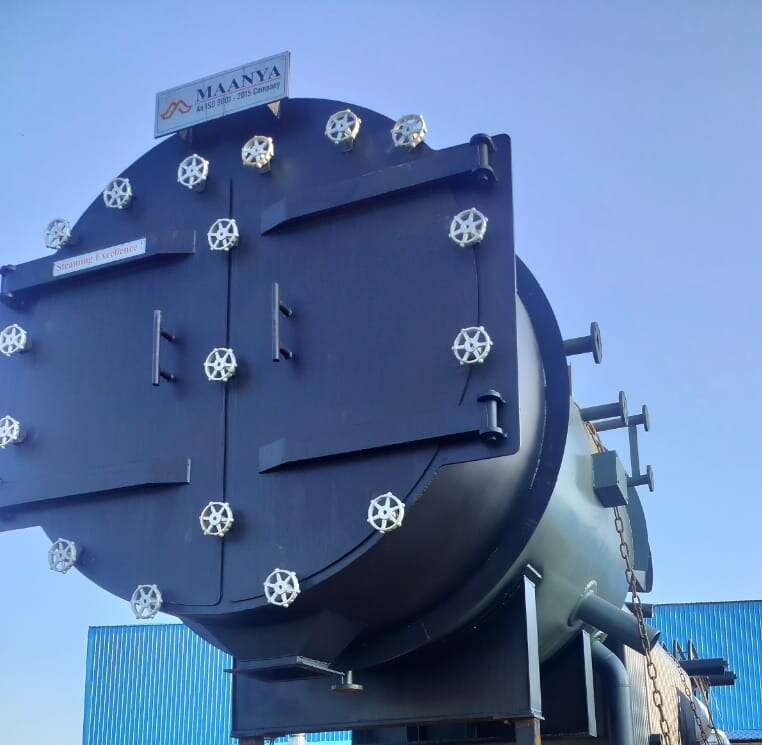
No responses yet