

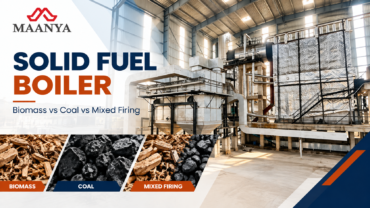
Choosing a Solid Fuel Boiler: Biomass, Coal or Mixed Firing
Choosing a solid fuel boiler is not simply a question of which fuel costs less per tonne. The fuel’s calorific value, moisture, ash, particle size and availability directly influence combustion, steam generation, fuel consumption and maintenance.
This matters as industries seek flexible, efficient process-heat solutions. The IEA reports that heat accounted for almost half of global final energy consumption and about 37% of energy-related CO₂ emissions in 2024. It also identifies bioenergy as an important source of renewable industrial heat.
For this reason, choosing between biomass, coal, and mixed firing requires looking at the entire boiler system, not just the fuel price.
Biomass vs Coal vs Mixed Firing: What Really Changes?
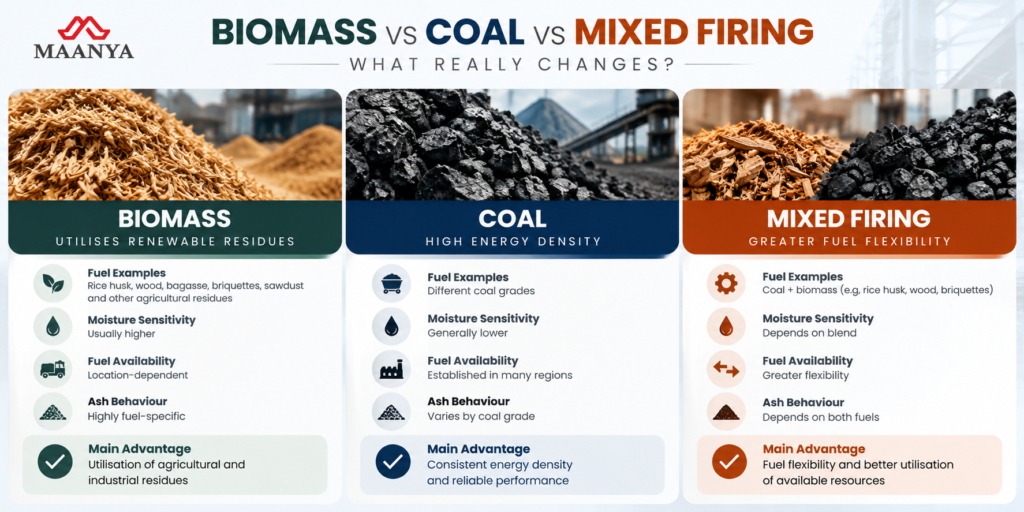
A solid fuel-fired boiler can use fuels such as coal, rice husk, wood, bagasse, sawdust, briquettes, pellets, and other agricultural residues. However, the combustion system must be designed around the fuel’s physical and chemical characteristics.
| Factor | Biomass | Coal | Mixed Firing |
| Fuel examples | Rice husk, wood, bagasse, briquettes | Different coal grades | Coal + biomass |
| Moisture sensitivity | Usually higher | Generally lower | Depends on blend |
| Fuel availability | Location-dependent | Established in many regions | Greater flexibility |
| Ash behaviour | Highly fuel-specific | Varies by coal grade | Depends on both fuels |
| Main advantage | Utilisation of residues | Consistent energy density | Fuel flexibility |
| Main challenge | Variable fuel quality | Ash and emissions | Combustion control |
The key difference is that fuel selection directly influences boiler design. A boiler designed for one type of solid fuel may not deliver the same performance when another fuel is introduced without suitable changes to the feeding, grate, furnace and air-distribution systems.
For this reason, industries should assess the actual characteristics of the available fuel, rather than choosing a boiler based only on the fuel’s name or purchase price. This matters most with biomass or mixed firing, where fuel quality and availability can vary widely.
Biomass: Attractive When the Fuel Supply Is Reliable
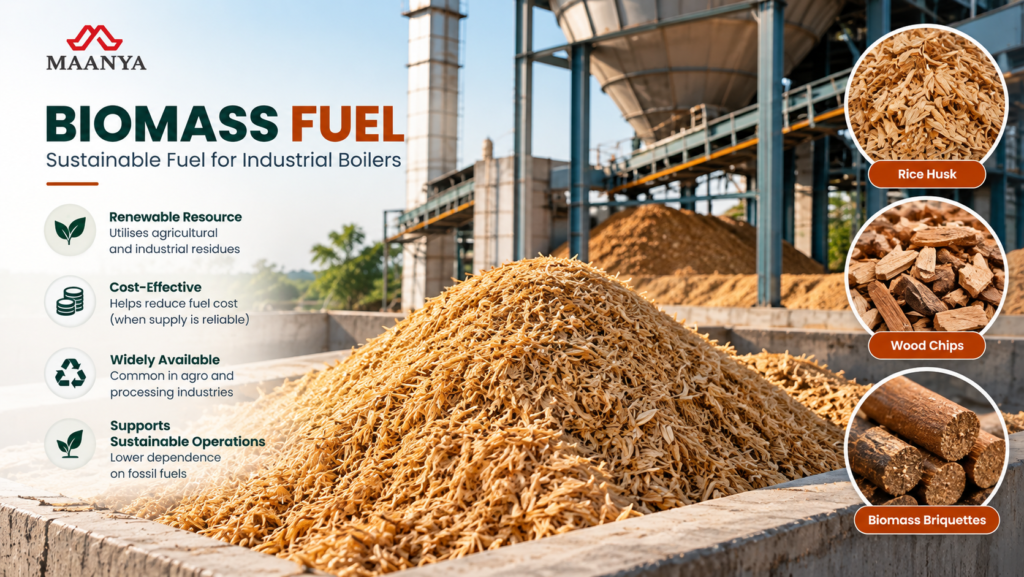
Biomass can make strong practical sense when an industry has access to a steady supply of rice husk, wood waste, bagasse, sawdust, briquettes or other agricultural residues.
This is particularly relevant for rice mills, sugar plants, food-processing units, plywood manufacturers and agro-processing industries. The IEA reports that India’s growth in renewable industrial heat has been strongly linked to the sugar and ethanol industries using biomass residues, along with increased use of biomass briquettes in industrial boilers.
However, biomass is not one uniform fuel. Rice husk, wood chips and briquettes can have very different moisture, bulk density, ash content and combustion characteristics. These differences affect the way fuel moves through the feeding system and burns on the grate.
Moisture deserves particular attention. If biomass contains substantial water, some of the heat released during the combustion process is used to evaporate that moisture rather than producing useful heat for steam generation. This means two biomass fuels purchased at the same price per tonne can have very different effective fuel costs.
Maanya’s rice husk vs coal guide provides a useful comparison of calorific value, ash, storage, handling and boiler compatibility.
Coal: Energy Density With Greater Emission Considerations
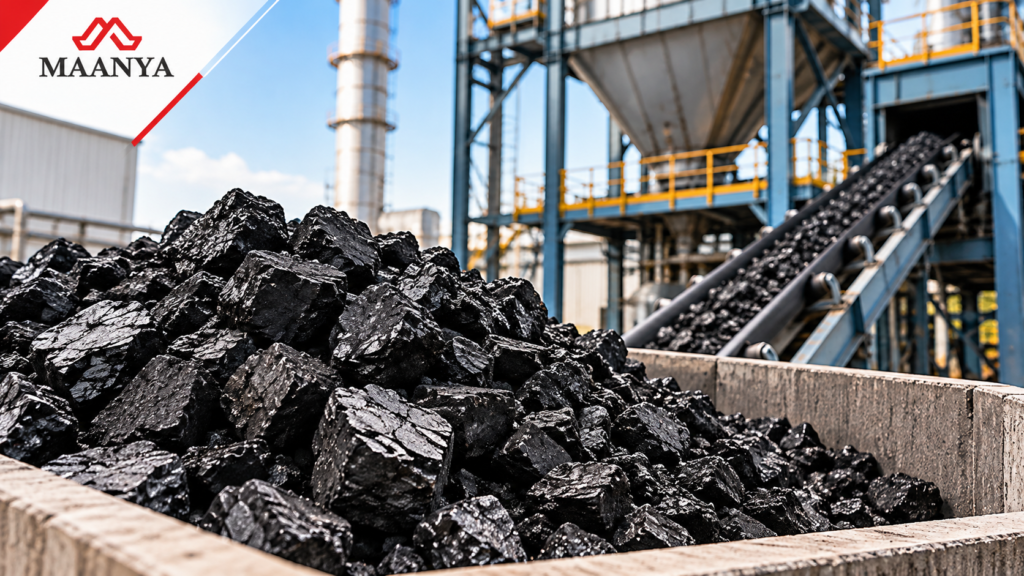
Coal remains an established fuel for many industrial solid-fuel boilers, particularly where suitable grades are readily available, and the plant already has coal-handling infrastructure.
Its relatively high energy density can reduce the fuel mass required for a given heat input compared with some lower-GCV biomass fuels. However, coal quality can vary significantly in terms of moisture, ash, volatile matter, sulphur and calorific value.
The environmental side also needs consideration. According to the US EPA, emissions from coal combustion depend on fuel composition, boiler type, firing conditions, operating load, and pollution-control equipment. Particulate matter, sulphur oxides and nitrogen oxides are among the major pollutants associated with coal combustion.
This makes delivered coal cost only one part of the calculation. A plant should also consider ash handling, emission-control equipment, maintenance and applicable environmental requirements.
Mixed Firing: More Flexibility, But More Engineering
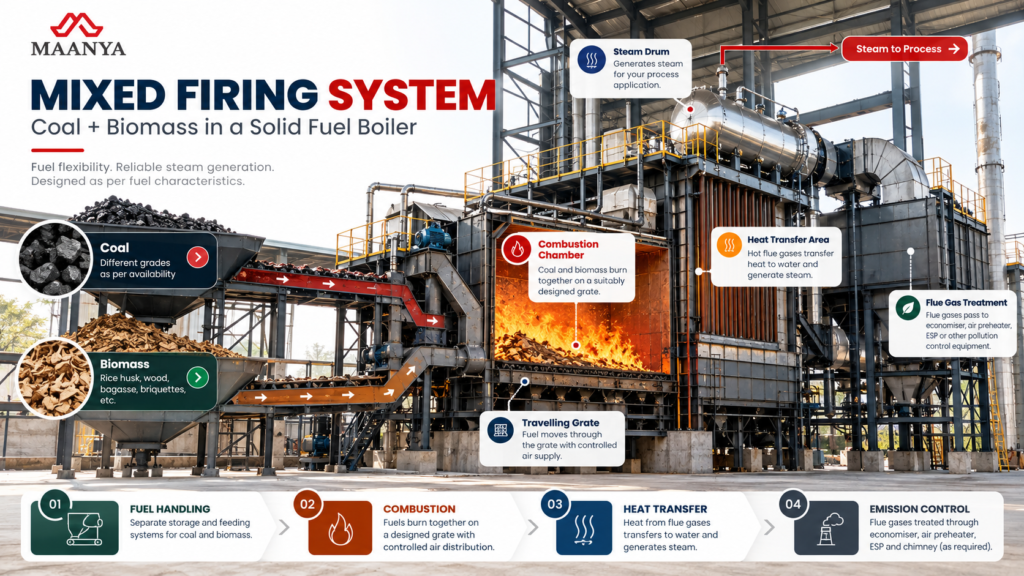
Mixed firing allows a solid fuel boiler to use combinations such as coal and biomass, or biomass with briquettes and other suitable solid fuels.
The biggest advantage is fuel flexibility. If biomass supply becomes seasonal or prices fluctuate, an industry may have another fuel available to maintain production.
But mixed firing should not be treated as simply putting two fuels into the same furnace.
Different fuels can have different:
- Moisture levels
- Particle sizes
- Bulk densities
- Volatile matter
- Ash characteristics
- Combustion rates
These differences can affect feeding, air distribution, grate operation, burnout, and steam-pressure stability.
For this reason, the boiler, fuel-feeding equipment, and combustion system should be designed around the intended fuel combination.
Maanya’s Biomax Boiler is designed for biomass and multi-fuel applications, including wood, coal, briquettes and agro-residues, with configurations available for higher-capacity industrial applications.
The Fuel Alone Does Not Determine Boiler Efficiency
One of the most important points when comparing solid fuel boilers is that a higher calorific value does not automatically mean a more efficient boiler. Actual performance depends on how effectively the boiler converts the fuel’s chemical energy into useful steam.
Key factors include:
Fuel quality
Obtain a representative fuel analysis covering GCV, moisture, ash, volatile matter, sulphur, and particle size.
A boiler designed for relatively consistent coal may not perform properly if the fuel is suddenly replaced with high-moisture biomass without appropriate modifications.
Furnace and grate design
The furnace must provide suitable residence time, temperature, and air distribution for the fuel being burned.
Grate design is particularly important in solid-fuel systems because the fuel must be continuously moved, exposed to combustion air, and eventually discharged as ash.
Excess air
Too little air can also cause incomplete combustion and higher unburnt carbon. Excessive air can increase heat losses through the flue gas.
Therefore, combustion control needs to maintain the appropriate air-fuel relationship rather than simply supplying as much air as possible.
Ash behaviour
Ash is more than a disposal issue. Its melting and deposition characteristics can influence grate operation, fouling and heat-transfer performance.
This is one reason why fuel testing should form part of boiler selection.
Biomass, Coal or Mixed Firing: Which One Fits?
| Plant condition | More suitable approach |
| Reliable rice husk or agro-waste supply | Biomass |
| Established coal supply and handling system | Coal |
| Seasonal biomass availability | Mixed firing |
| Multiple locally available solid fuels | Multi-fuel |
| Fuel strategy expected to change | Flexible boiler configuration |
This is why there is no universal best solid-fuel boiler. A rice mill with abundant husk has very different requirements from a chemical plant purchasing fuel from external suppliers.
Why Maanya Boilers Can Be Considered for Solid Fuel Applications?
Selecting a solid fuel boiler requires matching the combustion system with the fuel, steam requirement, operating pressure, and plant conditions.
Maanya Boilers manufactures industrial boiler systems for biomass, coal, and other solid fuels, with different configurations for varying capacities and applications. Its published range includes solutions for rice husk, wood, briquettes, pellets, coal, and agro-residues.
The company’s industrial boiler manufacturing offering also covers engineering, manufacturing, testing, commissioning, and after-sales support. This application-based approach is particularly relevant when an industry needs to evaluate fuel flexibility rather than purchase a standard boiler.
Conclusion
Choosing between biomass, coal and mixed firing requires more than comparing fuel prices. Solid fuel quality, moisture, GCV, ash behaviour, fuel availability, combustion technology, steam demand and emission requirements all affect the final economics.
Biomass can be highly practical where reliable residues are available. Coal may suit plants with established fuel infrastructure, while mixed firing provides flexibility where fuel availability varies.
The right solid fuel boiler is designed around the plant’s actual operating conditions, fuel characteristics and long-term production requirements.
Frequently Asked Questions
1. What is a solid fuel boiler?
A solid fuel boiler burns fuels such as coal, rice husk, wood, briquettes, pellets or other biomass to generate steam or hot water for industrial processes.
2. Is biomass cheaper than coal for boilers?
Not necessarily. The right comparison should consider delivered fuel price, GCV, moisture, boiler efficiency, handling, ash disposal, and maintenance, not price per tonne alone.
3. Can a solid fuel boiler burn both coal and biomass?
Yes, if the boiler and combustion system are specifically designed for multi-fuel or mixed-firing operation.
4. Why is moisture important in biomass fuel?
Higher moisture reduces the useful heat available from the fuel because energy is required to evaporate the water during combustion.
5. What is the advantage of mixed firing?
Mixed firing reduces dependence on a single fuel and provides greater flexibility when biomass or other solid-fuel availability changes.
No responses yet