

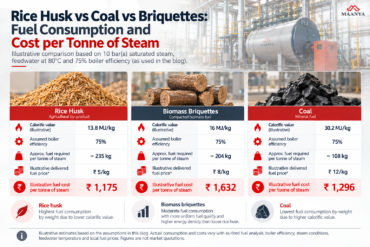
Rice Husk vs Coal vs Briquettes: Cost per Tonne of Steam
When industries compare boiler fuels, the purchase price per tonne can be misleading. What matters is how much usable heat each fuel delivers and how efficiently the briquette boiler, biomass boiler, or coal-fired system converts that heat into steam.
Rice husk has a lower heating value than coal, while briquettes offer higher energy density and more consistent handling. The FAO reports a lower heating value of about 13.8 MJ/kg for rice husk in one biomass assessment.
Therefore, the right comparison is the fuel cost per tonne of steam, not simply the cost per tonne of fuel.
What Determines the Cost of Producing One Tonne of Steam?
The cost of producing steam depends on five interconnected factors:
- Fuel price delivered to the boiler
- Calorific value of the fuel
- Boiler efficiency
- Moisture and ash content
- Steam pressure and feedwater temperature
A fuel with a low purchase price can become expensive if its moisture content is high or its calorific value is low. Similarly, a more expensive fuel can sometimes produce competitive steam if it provides greater usable heat and burns efficiently.
This is particularly important when comparing rice husk, coal and biomass briquettes.
The basic calculation is:
Fuel required per tonne of steam = Heat required for steam ÷ (Fuel calorific value × Boiler efficiency)
The final fuel cost is then:
Cost per tonne of steam = Fuel required × Delivered fuel price
Calculate steam properties using recognised steam tables. IAPWS-IF97 is the internationally recognised industrial formulation for calculating thermodynamic properties of water and steam.
Rice Husk vs Coal vs Briquettes: Fuel Comparison
The three fuels behave quite differently inside an industrial boiler.
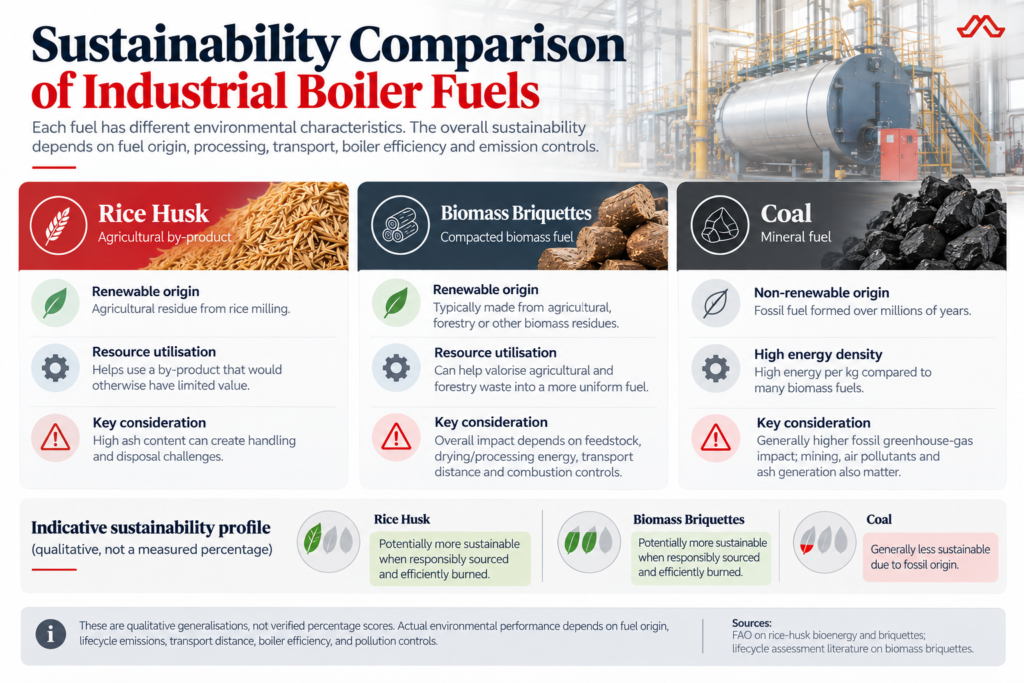
| Parameter | Rice Husk | Coal | Biomass Briquettes |
| Typical energy density | Low | High | Medium to high |
| Fuel form | Loose agricultural residue | Dense mineral fuel | Compacted biomass |
| Moisture sensitivity | High | Moderate | Moderate |
| Ash | Can be high | Varies by grade | Depends on feedstock |
| Handling | Requires suitable feeding | Established systems | Easier than loose biomass |
| Main advantage | Useful milling residue | High heat per kg | More uniform biomass fuel |
| Boiler consideration | Grate, feeding and ash handling | Combustion and emissions control | Briquette feeding and combustion |
The FAO reports rice husk heating values around 14 to 16 MJ/kg, while also noting its relatively high ash content of around 16 to 23% in the cited rice-hull application.
Coal varies considerably by grade. In India, non-coking coal is classified by GCV, with notified grades ranging from below 2,200 kcal/kg to above 7,000 kcal/kg, as per the Ministry of Coal. This is why using a single generic coal price or calorific value for every industrial calculation can produce misleading results.
How Much Fuel Is Needed for One Tonne of Steam?
Consider an illustrative calculation for producing one tonne of saturated steam, using approximately 10 bar(a) steam and feedwater at 80°C. Standard steam-table values put saturated-steam enthalpy at about 2,778 kJ/kg at 10 bar(a); always calculate the exact requirement from the plant’s actual pressure and feedwater conditions.
For this example, assume an overall boiler efficiency of 75% purely to compare the fuels on the same basis.
| Fuel | Illustrative heating value | Approx. fuel required/tonne steam* |
| Rice husk | 13.8 MJ/kg | ~235 kg |
| Biomass briquettes | 16 MJ/kg | ~204 kg |
| Coal | 30.2 MJ/kg | ~108 kg |
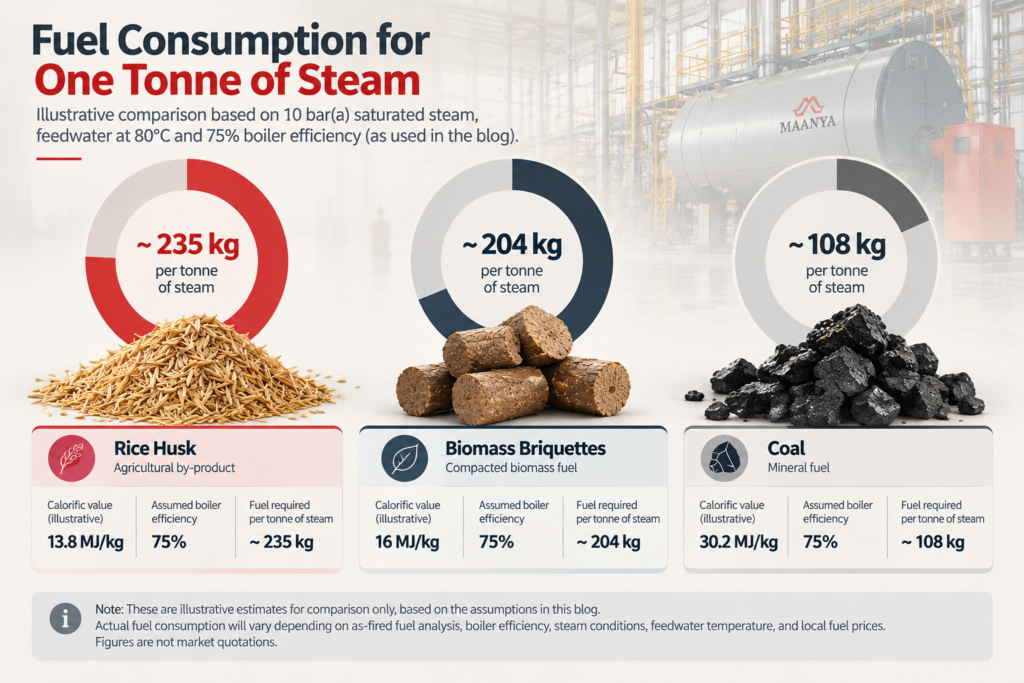
*Illustrative calculation using the same assumed boiler efficiency. Actual consumption depends on as-fired fuel analysis, boiler efficiency, steam conditions, and feedwater temperature.
The rice husk value of 13.8 MJ/kg comes from an FAO biomass-briquette assessment, while the cited FAO rice-residue data also places dry rice husk around 15.25 MJ/kg.
This difference matters. Briquettes can require less fuel by mass than loose rice husk because properly produced briquettes generally have greater density and can offer a more consistent fuel specification.
However, briquette manufacturing quality matters. Feedstock, moisture, binder, compaction, and particle characteristics can all influence the final fuel’s performance.
Cost per Tonne of Steam: The Calculation That Actually Matters
Fuel prices vary significantly by region, season, transport distance, and supplier. So, publishing a single universal market price for rice husk, coal, or briquettes would be misleading.
Instead, consider this illustrative delivered-price calculation:
| Fuel | Assumed delivered price | Approx. consumption | Illustrative fuel cost/tonne steam |
| Rice husk | ₹5/kg | 235 kg | ₹1,175 |
| Biomass briquettes | ₹8/kg | 204 kg | ₹1,632 |
| Coal | ₹12/kg | 108 kg | ₹1,296 |
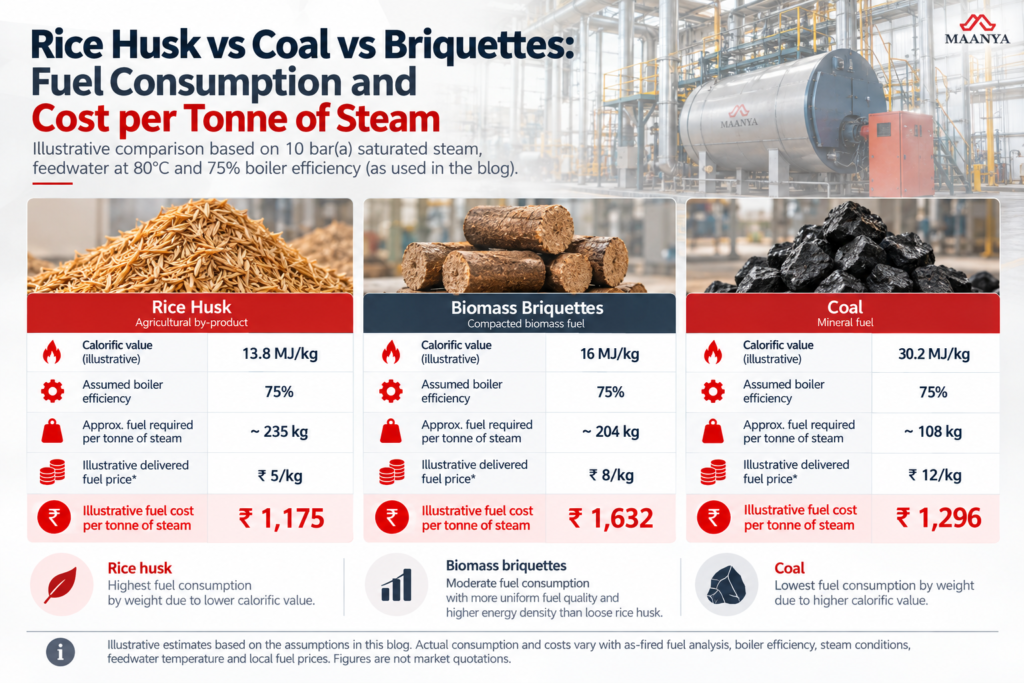
These prices are example assumptions, not current market quotations. They are meant to demonstrate the calculation. The table also highlights an important point: the cheapest fuel per tonne is not automatically the cheapest fuel for steam generation.
Why Moisture and Ash Can Change the Economics
Moisture Reduces Usable Heat
Moisture is particularly important for biomass fuels. Water contained in the fuel consumes part of the combustion energy during evaporation, reducing the heat available for steam generation.
This is why a boiler calculation should use the as-fired GCV or LHV, rather than simply relying on a published dry-basis number.
Ash Creates Operational Costs
Rice husk can produce substantial ash. Its silica-rich ash can also influence furnace cleaning and ash-handling requirements.
Coal ash varies significantly according to coal grade and source. Consequently, the cost comparison should include ash removal, disposal, cleaning and maintenance rather than stopping at the fuel invoice.
Rice Husk, Coal or Briquettes: Which Is Economical?
Rice husk is particularly attractive for rice mills where the residue is generated on site. Maanya Boilers’ guide to rice mills and husk-fired boilers explains how fuel availability, moisture, feeding and combustion requirements influence boiler selection.
Coal provides considerably higher energy per kilogram in many applications, reducing the mass of fuel required. India’s Ministry of Coal grades non-coking coal by GCV, showing how much coal quality can vary.
Biomass briquettes can be useful when industries want a more compact, manageable biomass fuel. Their performance depends heavily on the raw material and briquette manufacturing process.
For a detailed background comparison, see Maanya Boilers’ guide to rice husk vs. coal for Industrial Boilers.
What Should Industries Include in a Real Cost Calculation?
A proper fuel-cost study should include:
- Delivered fuel price
- As-fired calorific value
- Moisture content
- Boiler efficiency
- Steam pressure and temperature
- Feedwater temperature
- Fuel consumption
- Ash generation and disposal
- Fuel handling and storage
- Labour and maintenance
- Transportation
- Pollution-control requirements
For example, a briquette boiler may have a higher fuel purchase cost than a loose agricultural residue system, but its handling characteristics may make storage and feeding more manageable. Likewise, a rice-husk system may have attractive fuel economics at the mill but become less attractive if the husk must be transported over long distances.
Why Maanya Boilers Can Be the Right Choice for Fuel-Based Steam Generation?
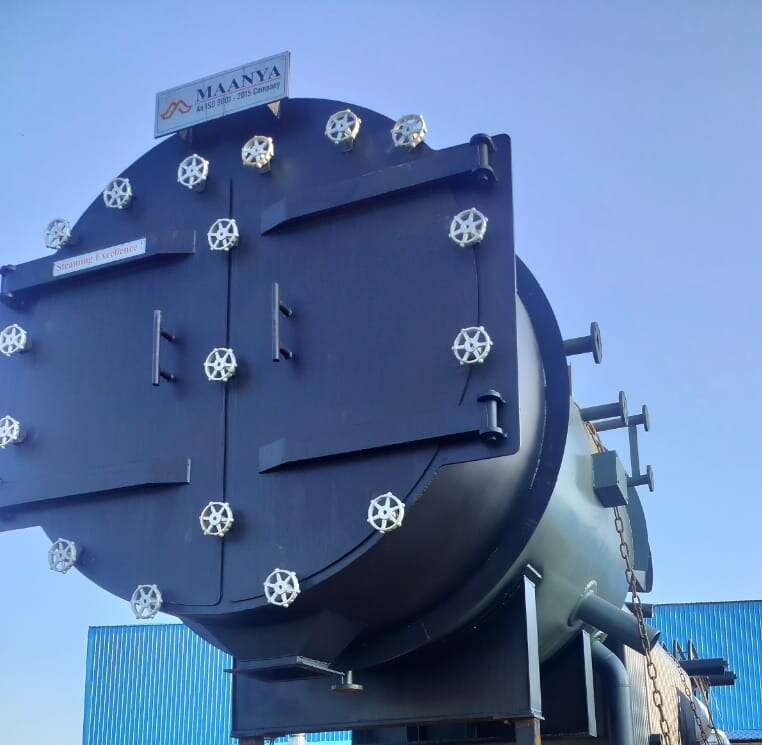
Maanya Boilers designs industrial boiler solutions for different fuels and process requirements, including rice husk, biomass, briquettes and coal. Its range includes biomass and multi-fuel systems such as Biomax, as well as packaged solutions such as Maxpac.
For industries comparing a briquette boiler with rice-husk or coal-fired alternatives, Maanya can assess steam capacity, fuel characteristics, operating pressure, feeding requirements, and ash management before recommending the appropriate configuration.
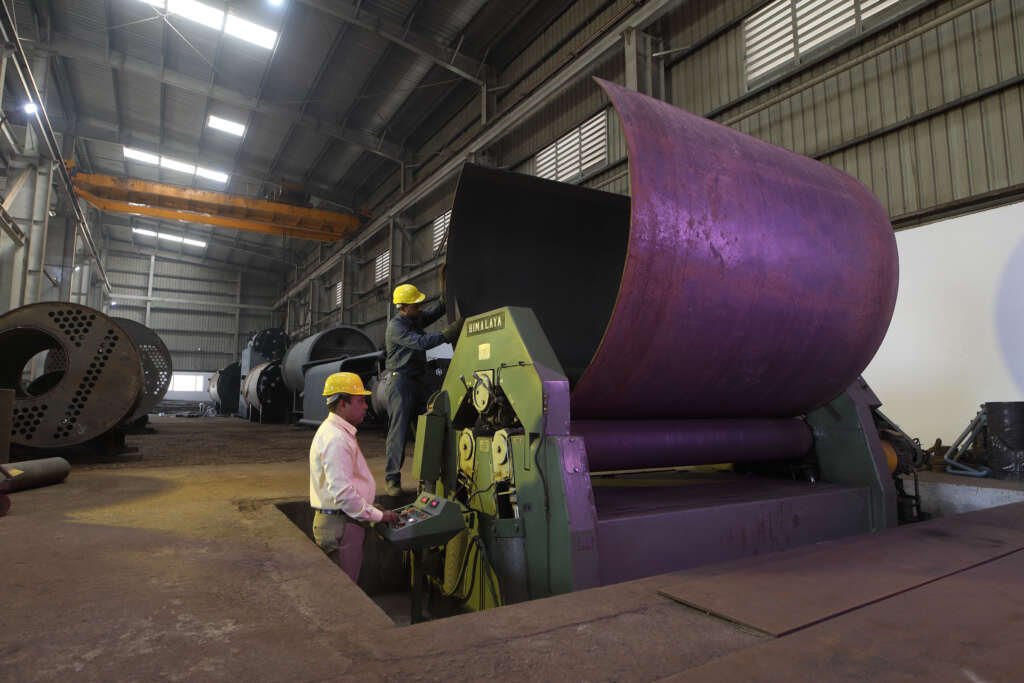
You can also explore Maanya’s range of industrial boilers or its industrial boiler manufacturing capabilities when evaluating a new installation or replacement.
Conclusion
The cost per tonne of steam depends on much more than the price paid for a tonne of fuel. Rice husk can be highly economical when generated close to the boiler, coal offers high energy density, and briquettes provide a compact biomass-fuel option.
The most reliable comparison uses actual as-fired calorific value, moisture, boiler efficiency, steam conditions, and delivered fuel cost. A properly matched briquette boiler or biomass boiler can therefore significantly affect long-term steam-generation economics.
Frequently Asked Questions
1. Is rice husk cheaper than coal for steam generation?
It can be, particularly where rice husk is generated on site. The actual answer depends on delivered fuel cost, moisture, GCV, boiler efficiency and handling costs.
2. How many kg of rice husk are required to produce one tonne of steam?
There is no fixed quantity. Under the illustrative conditions used above, we calculated approximately 235 kg, but actual consumption should be based on the boiler’s measured efficiency and as-fired fuel analysis.
3. Are briquettes more efficient than loose rice husk?
Not automatically. Briquettes can provide greater density and more consistent handling, but actual thermal performance depends on their composition, moisture content, calorific value, and boiler design.
4. What makes a briquette boiler suitable for industrial use?
A suitable briquette boiler needs a combustion chamber, grate or firing arrangement, fuel-feeding system, and ash-handling system designed for the specified briquettes’ characteristics.
5. Why does moisture matter so much in biomass boilers?
Moisture consumes combustion energy during evaporation, reducing the useful heat available for steam generation. That is why as-fired fuel testing matters.
No responses yet